Sunday, May 19, 2013

Swimming with Critters

Swimming, sort of
Scorpions and flies do not swim very well. Either that, or they can't climb out of a swimming pool very well. Or maybe the ones around the desert never learned how to swim. In any case, this scorpion drowned and it's the time of year when flies get stuck in the pool.

We've been keeping the pool covered, especially overnight when the temperatures drop. Sometimes there's a little surprise when we uncover.

Usually it's a horde of flies. The silly critters like to drink; odd, eh? Trouble is, once they dip, they're stuck. I wonder if they ever figure out about surface tension.

Oh well. No need to mourn too many of them. Once they are skimmed out with my trusty swimming pool skimmer-net, they revive in a few tens of minutes. Happy, but none the smarter.

Drying out, sort of
Couple of mornings ago, we had a nice surprise. Well, it was a lot less nice for the scorpion on the bottom of the pool. Looks like it gave up the ghost while in a ready-to-sting posture. Dead. Defunct.

So far I've seen two kinds of scorpions around here. This is the big, kinda orange colored. The other kind is small and dark. They say it's the sting of the small ones that are more nasty. I don't have the experiences to compare, but the sting I got from one of the small guys was only a nuisance.

This guy was about three inches long. I can't be sure because it was stuck in the ready-to-sting position. It may have been defunct, but I didn't want to unwind its tail.

Good thing we shocked the pool a couple three weeks ago. ("Shock" in the world of swimming pool maintenance means overdosing on chlorine.) Our water is nice and clear. I can spot a small pebble on the deep bottom. So it's not like there is any risk of swimming with critters.

When monsoon season comes, we'll be fishing frogs out of the pool. Meanwhile, Shari has taken to swimming in the cool mornings when the water is only 92 degrees.

.

Tuesday, May 7, 2013

Sewing Projects


The shade cover over the garden is nicely tailored, thanks to Shari's hard work. And the plastic sheet that came with the gazebo has been replaced with sun-shade cloth, again thanks to Shari's skill with her sewing machine.

Meanwhile, through the use of a solar blanket, cut to shape by seamstress Shari so that it fits within the pool perfectly, the water in the cement pond is about 90 degrees. Nice.

Twenty laps; that's twenty times back and forth, forty times the forty-five foot length of the pool.

It's not the English Channel, but it would drown me. That's what Shari will swim, given some warm water, a sunny afternoon, and only a little wind.

I just dip, maybe do a couple of laps, float with the styrofoam noodles, maybe do a couple of laps, then get out and water some plants.

Monday, April 1, 2013

Outdoor Projects

What are our new projects? Maybe you didn't ask, but you could.

I can't write for Shari. She's busy sewing shade fabric for the vegetable garden and making beautiful jewelry out of pieces of silver, argentium, solder and gold foil.

But Tucson Tom has a few things to boast about. Like the new driveway. It's been paved with new asphalt and -- no extra charge -- dusted with Portland cement. The benefit is a lighter color that absorbs less heat. The downside is that it looks like it's been dusted with Portland cement.

There is not much that I like about the light grey-green shade of pure Portland cement.

Not to worry. We've etched cement before and we still had some of the iron-laced acid that we had used. Washed it on and the color changed. A bit too rusy-yellow instead of rusty-red, but still an improvement. We are actually getting used to it.

We had only half of the driveway surfaced. The gravel by the house is too important a rest area for the furry kids to be paved. Given how -- shall we say -- unusual the etched/cement/asphalt looks, I think we will complete the rest with something more conventional, like crushed Yavapai coral rock with its rosy-red color.

Speaking of the driveway, I've been clearing on the other side of it from the house. This is the little gully below our house, on the south side, where most of our acre lot is located. It's actually a very pretty gully with several palo verde, acacia and mesquite trees.

The clearing opens up the area so it's easier to walk through. I've been planting extra blue and green agaves there, some of the many agaves I have been thinning and transplanting elsewhere in the yard. Now I am moving rocks to help define paths. Actually, moving rocks and stray gravel is one of my favorite outdoor activities.

Parking-out the yard on the other side of the driveway wasn't enough. I didn't like the low, stuccoed cinder-block wall that seems to act as an energetic barrier (bad feng shui or vastu). It discouraged stepping over it to explore beyond the driveway where quail, rabbits, lizards, cactus wrens, ground squirrels and chipmunks make their homes. And the view is nice, too.

Well, it was nothing that a sledge hammer couldn't fix. And a little stucco patch, a couple of bags of mortar mix, and some red clay bricks to create a little area on the other side.

Out with the meyer lemon tree . . .
There's at least one other part of the driveway boundary wall that I'd like to punch out. That would entice walking to the area where I transplanted the meyer lemon tree.

The origin of the transplanting is an increasing recognition that our queen palms and climate change don't mix. The cold snaps in winter are getting more frequent and severe, and there may come a time when the two big queen palms by the pool give up the ghost.

Mexican fan palms are supposed to tolerate frost a bit better, so we decided to start planting them as a contingency.
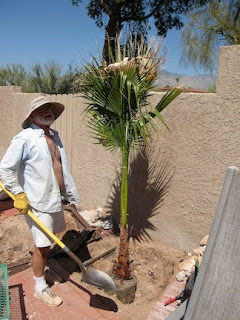
. . . in with the Mexican palm.
The meyer lemon tree by the pool really wasn't doing much. So Tucson Tom dug it out and that's where we planted our new Mexican palm.

Rather than chopping up the citrus tree, we transplanted it. Yep, you guessed it. On the other side of the driveway. If it survives the shock -- odds are not in its favor -- it will be the anchor for the new vegetable garden that Tucson Tom will build for his honey -- maybe next year.

For now, the small vegetable garden by the pool will serve for another season.

Last year, little critters munching on last year's produce made me build a frame and wrap it in wire mesh. Trouble is, we kept forgetting about the low cross-braces and we kept bashing out heads. So Saturday, Tucson Tom screwed on some strips scrap plywood to raise the braces, and therefore the roof.

Which is why the structure is now entirely covered with brand new and architecturally soothing shade fabric. It hides the Rio slum, favela-style extension. Give Shari a little time; she'll have it hemmed properly. Meanwhile, the new little veggie plants are thriving under the semi-shade. That's all Shari's work. I clear vegetation. She makes stuff grow.

I have to admit, I love being outside.

From Winter into Summer

View of Lake Washington from our nephew's house in Seattle.
Somehow we missed Spring. Before we left for a short, three-night trip to Seattle, we were wearing sweaters in the morning. Come back, and it's warm in the mornings, hot in the afternoon, and we are wearing shorts 24/7.

We did enjoy the weather by the Salish Sea: dark, grey, cold and wet. Our enjoyment of that weather was greatly enhanced by the knowledge that we were shortly returning to the Sonoran Desert.

Still, we had just been getting used to wearing warmer clothes when all of a sudden, they look strangely out-of-place in our closet. Why would anyone have thick pants and sweaters?

Yesterday was Easter Sunday. I have lots of nice memories of Easter Sundays, particularly one sunny Spring day at the U-District house in Seattle: the huge tree that almost touched my bedroom window was loaded with cherry blossoms. Yesterday's Easter Sunday memory was swimming my first laps of the year in the cement pond.

Time to change my "gum tree" photo for something more seasonal.

Tuesday, March 26, 2013

Underlying Phoenix

Phoenix basin, view from South Mountain.
Phoenix is confirmation that we made the right choice to live in Tucson.

Some 4.2 million people live in a huge sprawl of houses, six-lane streets, freeways, shopping centers, industrial sites, and office buildings variously called Phoenix, Tempe, Glendale, Peoria, Mesa, Chandler and Scottsdale. As some Tucsonans have described it to us, it's like living in L.A.

When we were migrating between Whidbey and Tucson, we either avoided Peenix or drove through and past it. I had some curiosity about the place, but Shari wouldn't let me get off the freeway. From its many freeways, there wasn't much to see that was inviting.

Park of the Canals, Mesa.
When a sister needed a ride back to Mesa, I got to see tragically sad developments: impressive entrance gates, blocks and blocks of little houses, all pretty much the same shape, compressed together, driveways and garage doors, tiny manicured gravel yards with an occasional cactus. The most nightmarish feature was that every house was painted with the identical color.

A friend flew into Phoenix to attend a conference in Scottsdale. I drove up to bring her back home. So I can say I've also been to Scottsdale. But I don't think I really have been because Scottsdale is supposed to be impressive and I was not impressed driving its main street.

Then a few weeks back, another sister flew into Peenix to attend spring graining in Peoria. I finally got my chance to explore for a couple of days. Peenix has its attractions. The ones that interested me the most were the remaining Hohokam sites.

The platform mound at Pueblo Grande.
There was a time -- before the Corps of Engineers, commercial cotton and citrus farming, and climate change -- when the Salt and Gila Rivers flowed through the Phoenix basin year round. The Hohokam excelled in creating extensive irrigation canal systems that supported agriculture, fishing, water fowl, and the largest concentration of Hohokam settlements.

In the Park of the Canals, a somewhat shabby looking place in Mesa, one can see a remnant of the Hohokam canals. When the Merkins replaced Mexicans and O'odham to settle and farm, engineers laid out irrigation lines using the ancient Hohokam canals.

The ball court at Pueblo Grande.
The Pueblo Grande Museum, just east of downtown Phoenix, is the site of one of the largest Hohokam settlements, one that probably controlled access to the Salt River waters and therefore grew politically. It has a partially restored ball court and a large platform mound.

The museum itself is well worth the visit. Now the area is desert scrub scattered with industrial buildings, and the nearby Phoenix Sky Harbor airport looks barren and ugly. But the museum can excite the imagination to wonder how the small Hohokam city flourished among water streams and irrigated fields.

Which is what my sister's companion remarked taking in the view of the Phoenix basin from the top of South Mountain: Imagine what this vast area looked like when water flowed and it was farmed by the Hohokam.

Typical Desert Botanical Garden sculpture (on the left).
There are things to see in Peenix. Driving around trying to find Park of the Canals and then Pueblo Grande, then the motel in Glendale, I got to see downtown Tempe and Phoenix. I can see why ASU is a popular party school. Downtown Tempe is impressive. There's money in serving beer and pizza to college kids.

My sister, her friend, and I spent a wonderful couple of hours at the Desert Botanical Garden, beautifully laid out and maintained. Gourmet food in its main restaurant, an $18 admission, and a pleasant Sunday, it was crowded with better heeled sorts. The metal sculptures in the park were silly, perhaps reflecting the tastes and personal friendships of the museum's trustees. But the succulent gardens are spectacular.

There remain plenty of other sights I would like to see in Peenix, but I wouldn't want to live there.

Friday, March 1, 2013

Blog for Blog's Sake

Writing, like anything else well done in life, is a craft and an art.

For those who like to write, posts on a blog can become a personal expression of thoughts. Ideas or inspirations come and I get in the mood. I play with the ideas, thinking about what and how I want to express, and then the words flow out with a pattern of their own.

The work takes on a life of its own. More ideas come: metaphors, examples and tangents; symbols within symbols.

My favorite part, perhaps the most important, is the editing. The best editing is to take out the extraneous. Ideas become clear and a gift is made to the patient reader.

Readers may be few. Still, the satisfaction remains of writing; hopefully well. We garden, sing, cook, sew, play and paint with the slightly selfish hope that others may admire. But if others' admiration is the reason for what we do, we surely will be disappointed. I think it's good to have some consideration for how others might take in what we have done. The quality of our work is raised. But I think the practical and the ultimate realities are that we work for work's own sake.

Recently two good friends have been inspired to blog, and they in turn have inspired me. So let's all blog for blog's sake.

A fundamental tenet in most spiritual traditions is the attitude memorialized in MGM's lion-roaring motto: Ars Gratia Artis (Art for the Sake of Art). Therefore, bloggers who craft their posts can honestly consider themselves performing a religious duty.

Thursday, February 21, 2013

Snow in Tucson


That big winter storm from Alaska that's sweeping across the Midwest had its effect on Baja Arizona yesterday.

Yesterday's low in Tucson itself -- a smidgeon warmer than us in the Foothills -- was 33 degrees with a high of 52. More impressive, we got about a third of an inch of precipitation, much of it in the form of wet snow.

Where we live, local rainloggers logged over a half an inch.

We spent yesterday in a gray snow-clouds, but as I like to say, if you don't like the weather here, wait a few hours.

It's still early morning and the clouds over the Santa Catalina Mountains are just beginning to clear. The big payoff is seeing sunlight playing over the snow-clad mountains.

For local skiers, the pay-off is skiing on top of Mount Lemmon (9157 feet elevation) or, as the Tohona O'odham call it, Frog Mountain (Babad Doʼag). It's the summit of the Catalinas. There's a chairlift there among the aspens, but the slope really only merits a rope tow.

It will take a few days for all the snow to melt. The forecast is for increasingly warmer and sunnier days -- today some clouds; then all clear by mañana.

The nearby Rillito River should be flowing with the runoff. It's not like monsoon rains when we can get several inches of wet in a day, but there will be a pretty decent flow moving debris towards the Santa Cruz River (the main river by which Tucson was founded) and helping replenish our underground aquifers.

All in all, very nice weather for us -- it's the ornamental plants and trees that can't take frost that take a beating.