Tuesday, June 17, 2025

... and on the Seventh Day ...

... we happily worked our butts off.

On the third day, which was Thursday, Shelby and Bird finished the tiling and grouting in our bedroom and we moved back in that night ... after we scrubbed the tiles clean of excess grout film. That means vacuuming to pick up the big stuff and dust from scraping with a putty knife, then on hands and knees with a wet cloth and scrubbing the white film off the tile surfaces, then rinsing the cloth in a bucket of water that quickly turns milky white and has to be chucked. Then four or five mop jobs, letting the floor dry in between so we can see where there is still some grout film. We keep mopping until the water in the bucket no longer turns milky white. I dumped buckets and buckets, each four gallons, of white water in back. I think the old creosote bush is happy.

By Thursday, we had emptied Shari's studio into the living and dining rooms so it was ready for them to move on to the next room. As they worked on the studio, we emptied guest bedroom and my office. Saturday morning we scrubbed the grout film in the guest room and Shari's studio.

The weekend was rather mournful for me. I had to gut my office: boxing contents of drawers and shelves, then disassembling one desk, disassembling two credenzas, disassembling one IKEA Ivar shelving unit with drawer and glass cabinet components, and dragging them somewhere and somehow so I could remember how to put it all back together again. I have a lot of stuff in my office. In a sense, I was dismantling my identity and shoving it aside.

Shari was smarter when she took down her bookshelf: first she took a photo so she knew how it was organized.

I had seriously underestimated the volume of stuff. We had five packing boxes left over from our move two years ago. I thought I'd buy six more small boxes at Home Depot and that should do it. Hah! It took two more trips to Home Depot and another twenty-two boxes. Now that everything is moved back in, we have a nice stack of thirty-three empty, folded packing boxes in the garage.

Office floor tiles laid (L), then grouted and cleaned (R).
That Monday, Day Five, they tiled my office and finished the grouting on Tuesday. Tiling and grouting the four rooms had taken them six working days.

Day Seven, Wednesday, we cleaned the hazy film of grout in my office, scraping, vacuuming, scrubbing, and five times mopping. We did some more mopping of the guest bedroom, Shari's studio, and the hallways where grout dust had been tracked. Then we started moving furniture back to where they belonged. That seventh day was a long one, but we were eager to keep going because we knew could, and the rewards of returning to enhanced normalcy were significant. Over the next couple of days, we had our living room and dining room back.

I write "enhanced" normalcy because we no longer have petroleum carpets emitting formaldehyde and lord knows what other chemical fumes. How do we know? Our sinuses no longer clog up each night. The floors are so clean, so uniformly tiled, that in a pinch, the house could be used as a hospital ... you know, rooms can be disinfected and blood mopped up.

On the eighth day, we were rewarded. That morning, two carpenters showed up to install an "alumawood" trellis over the courtyard by our front door. It took them only three hours, which is a lot less time than what it took me to move out our courtyard furniture and potted plants.

The effect of the shade is marvelous. The summer heat here is bearable in the shade. If you are in direct sunshine, it's murder.

Wednesday, June 4, 2025

Day One


We were ready for it eight days earlier, clearing out furniture & stuff from our master bedroom (the "owner's suite") and stacking it in the —  for this purpose, the appropriately named —  "gathering room" (i.e., the living room). But Day One kept getting postponed.

The folds in the carpet, bumpy enough
to trip on, are circled in this photo.
We are having the carpets ripped out of four bedrooms and replaced with tiles. The guys showed up and started work yesterday, Day One.

We've been wanting to take out the carpets ever since we moved in here two years ago. Actually, the feel of the carpet on its thick padding was a bit luxurious, especially with bare feet in the winter. But its days were numbered. Not only do carpets store too much dirt and dust, and not only are cool tile floors more welcoming in the desert climate, but the developer and its carpet subcontractor had installed them very poorly. After only a few weeks, folds began to appear in the carpets in all four bedrooms.

Upon tearing up a corner of the carpet, I saw evidence to support a theory. The padding underneath was really thick. That's why the carpets felt so luxurious. Trouble is, the carpet tack strips nailed all around the edges of the floor are quite thin and the carpet layers cut the padding to abut close to the strips. By the time the carpet was laid down, the thick padding prevented it from being secured by the tack strips.

Tom is pleased with the tiles laid
on Day One
.

Day One is a big step forward.

It's going to take a while, one room at a time, to get the tiling done and return to some semblance of normalcy. We are hopeful.

Meanwhile, I need to drive down to Home Depot to get some more small boxes. Sheesh, I thought we were done with those a year and a half ago when we moved form San Simeon to Blue Agave II in Dove Mountain. But I have to move a lot of books out of my office. 

Saturday, April 26, 2025

İmam bayıldı

A typical imam bayıldı.
Our second date was dinner at Shari's apartment in Langley. She made imam bayıldı, a popular Ottoman dish of sliced eggplants stuffed with onion, garlic and tomatoes, then simmered in olive oil.

İmam bayıldı means "the imam fainted." The name derives from a story that an imam's wife prepared the dish which was so delicious that the imam swooned. Alternatively, the imam swooned because of the amount of olive oil used in the recipe. Suffice it to say that I swooned over the dish that Shari made for me on that second date.

Shari made imam bayıldı yesterday. The occasion was a periodic shopping visit at Caravan, our very, very favorite Middle Eastern grocery store, where she bought some of the small purple eggplants used to make the dish. We get things at Caravan we can't get anywhere else: shelves crowded with exotic and fragrant foods, spices, and utensils used in Middle Eastern cooking, whether North African (the owner, Mr. Soliman, is from Libya), the eastern Mediterranean, the Balkans, Turkey, Iran, and more. Caravan is where we buy our Krinos olive oil from Crete in 3-liter cans, our Iranian saffron, Armenian nazook pastry, different varieties of bulk imported olives, the occasional jar of caviar, Bulgarian jams, fresh made sheets of round Kurdish bread, etc. It's a pleasure shopping there, literally rubbing shoulders in the narrow aisles with all sorts of people from other parts of the world. Like Mr. Soliman himself, his staff is invariably hospitable, which is what to expect from a shop that closes each Friday afternoon for prayers.

The small purple eggplants inspired Shari to exercise her culinary magic. Her specialty includes Turkish and other eastern Mediterranean cooking. Eggplants were split, their flesh criss-crossed with a knife, then salted until the liquid could be squeezed out. Lots of fresh basil, dill and Italian parsley from Shari's garden were combined with stewed tomatoes, garlic, onions, kırmızı biber, olive oil and, something of which Shari was particularly pleased with, a tiny hint of cinnamon. The stuffed aubergines were baked slowly for ninety minutes, decorating the house with an appetizingly exotic fragrance.

Her imam bayıldı was nothing short of perfection: tender, flavorful, melt-in-your-mouth, swoon-worthy magnificent, more than enough to inspire me to write a very grateful blog entry.

Saturday, November 30, 2024

Small Walls, Big Difference

Front yards covered with crushed rock.

The way developers of residential tracts work, they do some basic wholesale landscaping in the front yards so the streets and houses all look neat, nice and ready to move in. Each front yard gets a tree or two (mesquite, palo verde or shoestring acacia), some bushes (Mexican bird of paradise, cenizo, or trumpet flower), maybe a golden barrel cactus, and lots of hardy, flowery lantana plants, all planted on small mounds of topsoil because each site has been stripped of its native soil down to the hard caliche.

Each front yard is dotted with three or four large boulders, weighing probably one or two hundred pounds each. The boulders are jagged, easily fractured reddish rocks of a variety mined some place else because, like the ubiquitous crushed rock, they are very different from the local native rock, especially the pale granite Catalina rock that is common to the Tortolitas as well as the Santa Catalina Mountains.

An automatic irrigation system is installed so the plants do not wither, die, or look bad over the weeks or months it takes to sell the house. Plus, many buyers are not into gardening and without automatic sprinkling, some lots would end up with dead plantings. That ruins the ambience of the developer’s neighborhood.

One of the grand entrances to the “Saguaro Reserve” tracts being developed just north of our tract.

When the developers bulldoze native vegetation, roads and building sites for a new tract, they always begin with the entrance and a grand monument bearing the pretentiously magnificent name for the tract, often named after a native plant that was bulldozed to clear the lots; like, “Saguaro Reserve,” “Blue Agave” and “Blue Agave II.” The entrance is the first area that the developers landscape. It makes a nice, finished first impression while the tract itself looks like an open pit mine.

The grand entrances and the front yards of each finished tract house are uniformly covered with the same crushed rock. In addition to desert-color conformity and the need to discourage lawns, the crushed rock serves to cover and hide a considerable amount of construction waste: bits of roof tiles and perimeter wall concrete blocks, plastic sheeting, styrofoam, nails, caffeine drink cans, candy wrappers, cardboard, and layers of concrete left over from when they mixed it on the caliche.

Digging the trench for the larger wall requires a jackhammer
to break up the caliche and some place to pile the dirt
.
In short, we live in a neighborhood where the front yards look alike and somewhat unnatural.

We inherited two mounds in our front yard that are a bit larger than what the developer dumped on other front yards. Looking out front at the mound outside my new office window, I would see the uniformly crushed rock everywhere, as well as three large, black plastic clean-out sanitary sewer drain caps. The front yard is also adorned with two storm drain outlets and a flat, rectangular metal cover with “Tuscon Water” written on it. To hide these embellishments, I covered the clean out caps and lined the house-facing sides of both mounds with native rock. Over the weeks we were moving in, I employed Agamemnon each day to bring a load of plants and rocks from our little acre on San Simeon. Now when I gaze out from my office window, I see my private view of native rock.

Shari’s very excellent stucco finish.

I tore out each lantana plant in the front yard (Shari is allergic to their pungent fragrance), and planted some small saguaros, barrel cacti, hedgehog cactus, pincushion cactus, a sotol (desert spoon), a Mexican fence post, and Mexican aloes to begin the process of making the front yard Tom-friendly.

Since March, out attention has been towards making the backyard livable. Now that the back is substantially completed, we have started work on redefining the two mounds where they face the street with low, cement block walls. Trenches have to be dug and it doesn’t take long before shovel meets caliche. Out comes my trusty electric jackhammer. Excavated dirt is neatly piled on double layered drop cloths until a level plane is carved out, pea gravel spread, and blocks placed.

Agamemnon’s load number four:
fifteen blocks, two 60 lb. bags of concrete mix,
and two tubes of Liquid Nails.

I can rough in the wall and stucco, but it takes Shari to smooth the cement finish so evenly that a stucco professional would be envious. Neighbors passing by on their walks stop to praise the work — in large part because of Shari’s finish.

Agamemnon has served valiantly hauling some eighty concrete blocks (2700 lbs), 28 concrete caps (some 225 lbs.), 360 lbs. of concrete mix, 120 lbs. of pea gravel, and 160 lbs. of stucco mix — six or seven trips; all in all some 3500 lbs. or over 1600 kg. Only one or two 80 lb. bags of stucco mix and a tube of Liquid Nails left to haul.

I used to identify our house by clicking the remote garage door opener. The house with the garage door opening was ours. Now guests can identify our house by the small, architectural walls in the front yard. Nice.

After seven days of work.

Monday, November 25, 2024

Backyard Bliss


It is a much smaller canvas than the little acre we had at San Simeon, but it has its charm and it requires a lot less work.

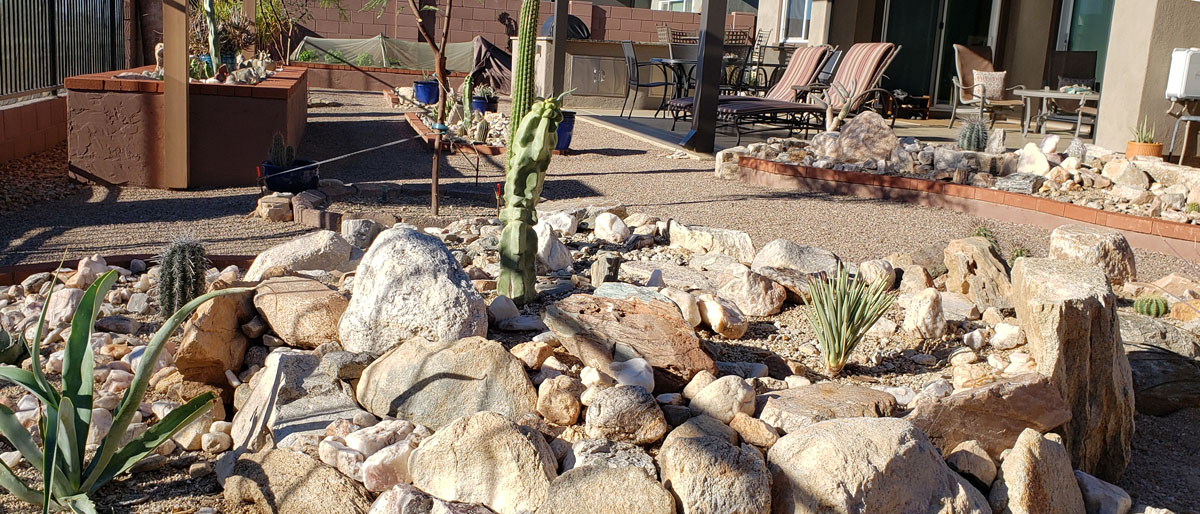
The huge pergola and two trellises provide shade, as will the two mesquite as they grow and spread wide. The planter on the right has already grown a bumper crop of basil, and the recently planted seeds of Chinese broccoli (gail lan or kailan), arugula, and dill have sprouted. The rest of the yard is devoted to drought-tolerant cactus, agave, yucca and euphorbia — “drought” being a somewhat odd term to use in the Sonoran Desert as the climate is mostly drought. Maybe “desert-tolerant” would be more appropriate.

“B-island” L to R: octopus agave, saguaro, totem pole cactus & behind it a golden torch cactus, joshua tree yucca.

From the drone perspective, the yard isn’t quite as interesting as from ground level. In my imaginative mind’s eye, I think of the rocks as Yosemite-sized walls.

“B-island” L to R: Hedgehog cactus, totem pole cactus, saguaro, artichoke agave (foreground), octopus agave.

“A-island,” “B-island,”
and the corn-husker.
As I carefully place large, medium and small rocks then scatter pebbles and sand scraped from wash deposits, I feel as if my childhood love of model trains has found a new expression.

Here we are in November and we have some flowers blooming. I like to think that is evidence that the plants are happy. (The alternative explanation is that the plants are desperately trying to propagate before they croak.)

Most plants don’t like being dug up and moved. It’s certainly true of cacti. I know the torch cacti we brought over in pots from San Simeon had trouble adjusting as their pots got moved out of the way several times over some nine months. I finally planted them under the big trellis over the raised desert garden.

A couple of smaller torches are still struggling, poor things, but two of the tall specimens seem to be happy being freed from the confines of a pot and finally planted. Either that, or the trellis shade allowed them to survive the summer sun, and now that the sun is lower on the horizon, they are able to enjoy its less fierce sunshine and decided to bloom. That's the fourth flower on the one on the left.

We still have several places available for additional plantings in C- and D-islands, but the sense of urgency has diminished because I know enough that some of these plant get big. For some like saguaros and joshua trees, that will take decades; for others, a couple of years and they will be crowded.

Another reason to shift attention is that we are now tackling the two “pony” walls in the front yard. The smaller one is up and I am using my trusty electric jackhammer to dig into the caliche for the trench in which the larger one will rest its bottom row of concrete blocks. Stay tuned.

Sunday, June 16, 2024

Construction Zone

The approved submittal sketch.

Well, it's been about ten weeks since they started digging up our backyard with the intention that it will look a little like the artist's conception image we submitted to the HOA police (the Architectural Review Committee of the Homeowner's Association) for approval.

So we've joined the Construction Zone.

There are scores and scores of new houses under construction to the north of us. By morning twilight, the warning bells of trucks in reverse gear can be heard together with the fire of nail guns and, occasionally, boomboxes playing Sonoran pop songs. Dove Mountain Blvd. becomes a regular stream of pick-up trucks and various construction company trucks, large and small, whether infrastructure businesses (licensed in Texas), concrete trucks, concrete pumps, cranes, plumbers, roofers, HVAC businesses, hardware delivery, landscape outfits, pest control firms — anything and everything you can imagine.

Then there are the swimming pools. Being a new development, every backyard comes with plain dirt, weeds, and construction debris. Many buyers decide to have a swimming pool constructed in their backyards, so there is a regular parade of worker bees and their trucks digging, laying rebar and concrete, etc., etc.

We've joined the club and we are having our own parade of workers: laborers digging holes and trenches, laborers using concrete blocks to fashion raised planting beds and an outdoor barbecue island, plumbers adding outdoor faucets and a natural gas connection for the barbecue, a crew setting up our backyard pagoda, electricians adding outdoor plugs and wiring for the adjustable louvers.

The plan involves a tall pergola over a concrete pad that extends out from the back patio, concrete paths from the side gate to the pergola, a barbecue area (of course), one raised garden for Shari, one raised garden for Tom (with trellis), a trellis outside our bedroom window, and a layer of crushed rock over all the dirt to keep the dust down.

The biggest spectacle was the concrete pour complete with concrete truck and concrete pump. In the morning, a team of workers showed up to finish laying the forms, digging out the cavities to be filled with concrete, and laying a crisscross of rebar, all just in time before the scheduled 8 a.m. arrival of the concrete truck. Also on site was a concrete pump with long sections of hose. Then, to the sound of a boombox dialed to Sonoran pop songs, the crew went at it. By noon, the concrete was all shaped and smoothed.

The building department inspector comes tomorrow to check electrical, plumbing and gas connections. Then, hopefully, we can complete the backfill.

For now, it's all still a bit of a mess ... a promising mess, but a mess. It will probably be several weeks before all the hired work is done, then more time for Shari and me to do clean-up and finish. When the workers are done hauling and spreading ten tons of crushed rock, we might have our backyard ready for our use — but I am trying to be upbeat. Rome was not built in a day.

So if anyone has been wondering what we've been up to this year, now you know.

Sunday, March 17, 2024

Tortolita Preserve in March

One of the pleasures of living in the Dove Mountain development is easy walking distance to the Tortolita Preserve. I have no need to get into my car. An alley a few houses down gets me to the Dove Mountain West Park where I follow the wash down and cross the barbed wire fence that surrounds the Preserve. Nature has graciously washed down a section of the fencing so it takes only a couple of ginger steps to walk over the barbed wire. Then it's cross-country following game trails, crossing under another barbed wire fence (the City of Marana leases the Preserve for cattle grazing), to reach the dirt road where there is an access point over a cattle guard. The formal trail starts there.

Or I can walk a few blocks along the streets of the Blue Agave developments to reach that cattle guard then walk the trail.

Walking through the Preserve one encounters countless magical scenes of greenery and budding wildflowers. This early spring, March, the lush greenery is simply stunning after the generous rains we have had over this winter.

The Tortolitas (Spanish for "doves") are a mountain range that peaks at 4,696 feet (1,431 m.). Some three decades ago, the Anglos who set out to develop the slopes used the name "Red Hawk." It took then a few years to realize that the Spanish name, dove, was a wee bit more inviting for new home buyers than hawk (especially a red hawk), so the name "Dove Mountain" was born. The area is incorporated within the town of Marana, also originally a Spanish name, "maraña," which means "thicket." The story goes that laborers dubbed the area Maraña on account of the thick vegetation they had to clear to make way for the railroad.

Even today, there is plenty of uncleared land with dense thickets of cholla, prickly pear and sage brush. On the upper slopes of Marana, in the Tortolita Preserve, there is plenty of maraña plus saguaros, ironwood, and palo verde trees.

Saturday, March 9, 2024

Wildlife on San Simeon

A video collection of wildlife taken on our little acre of the Sonoran Desert, including bobcats, javalina, mourning doves, Gila woodpecker, king snake, hummingbirds, chipmunks, rabbits, rattlesnake, Gamble's quail, Cooper's hawk, owls, bats, kangaroo mice, lizards, coyote, grackle, Colorado River toad, and even a raccoon.

Some are taken on my video camera; some on repurposed security cameras.

Wednesday, November 1, 2023

Foreign Life

The name of our sprawling detached hotel
development is lit up in the hours of darkness,

I feel like we moved to a foreign land and that we are camping in a nice hotel.

We lived on a secluded little acre for almost seventeen years, longer than either of us had lived any other one place. The Sonoran Desert, the Catalina Foothills, and Finger Rock wash became the home that we identified with and San Simeon reflected our identity for friends and family. The house itself with its sunken living room and huge window looking at Finger Rock, its walled backyard with a tower that viewed mountains in all directions, secluded swimming pool, and goldfish pond, its long driveway, eucalyptus trees, sixty saguaro cacti and similar number of palo verde trees, private gully and paths, its raised beds, shade covered garden protected from javalina, rabbit and serpent are all unique, unlike any other property, and all remodeled and fashioned with our own hands. Our two furry children are buried there. It's an acre like no other.

We knew our few neighbors, their properties similarly sprinkled an acre at a time by the Finger Rock wash. From our house, we could hardly see any of theirs. Standing at the south point of our own acre, even our own house was not visible. Of the ten neighbors on San Simeon, only two had lived there longer than we carpetbaggers from Puget Sound. Many were retired, or retired over the time we lived there — like us. I don't think any of us play golf and there are no snowbirds. It's a neighborhood established some fifty years ago. Families had been raised there, but over our years only one home had children.

We had lived in a very unique place so, of course, any other place would be different by definition. We moved only 25 miles away, but it is a completely different world; a foreign country. True, our new home is definitely within the Sonoran Desert and is situated about the same elevation as San Simeon, Dove Mountain folk speak the same languages as those in the Foothills, and the Tortolita Mountains are similarly spectacular with familiar pale Catalina granite and caliche, views, and majestic saguaro cacti, palo verde, mesquite, acacia, ironwood, barrel cacti, cholla, prickly pear opuntia, and desert wildflowers. But Dove Mountain is also very different.
Typical street scene in Dove Mountain: a line of garages with attached living quarters.

Everywhere it's a new development with many unoccupied houses and new areas under construction. Small lots. Huge houses packed next to each other in strips separated by common areas. Intentional builder and covenant-restricted uniformity in appearance, whether colors, fixtures, layouts and landscaping. In our development, Blue Agave II, every house number is uniform and advertises the builder whose name I will not mention. (Say, whose house is this anyway?) Properties look like lines of garages with attached dwellings. Boundary walls (two types: sloped rip-rap over concrete block base and thin red-brown concrete blocks). Flimsy iron gates and fencing. Backyards are left stripped down to the hard soil, barren, dusty, muddy when it rains, and generously sprinkled with half-buried construction debris.

We have lots of neighbors. It's been twenty-three years since I made my home in a small lot neighborhood. All kinds of people: lots of retired couples both permanent and snow birds, young families with kids, professional and military retired. Some folk have dark skin but most with white. Children accompanied by a parent walk past our house to the corner where school buses promptly arrive.

But all folk have something in common: enough money to buy a large, expensive and newly built house, able to spend even more money to finish fixturing it so it's livable, and — in about one in four properties — spend another hundred thousand having a large hole dug in their small backyard to accommodate a swimming pool, ramada and outdoor kitchen.

Our detached hotel on Chaparral Sage will become our home. Like San Simeon, the desert setting is gorgeous and the views stunning. We have discovered walks in the Tortolita Preserve that we can take without having to get inside a car and drive somewhere. And, to be honest, it's interesting to walk the manicured lines of garages with attached living spaces. But right now, I still have feelings like we are camping in a large hotel complex

Tortolita Preserve. A quiet, private walk past a hole in the barbed wire perimeter.
That's Baboquivari in the middle distance just to the left of the solitary saguaro.

These feelings will be forgotten as Dove Mountain becomes all too familiar and the thrill of something foreign fades.

Wednesday, October 4, 2023

The House at the End of the Universe

Dove Mountain Boulevard runs about seven miles from Tangerine Road up into the foothills of the Tortolita Mountains past innumerable residential, golf club, and resort developments. The road is landscaped and maintained, lined with hiking and biking trails through saguaro forests and thickets (maraña) of cholla and bushes, and graced with views of the Tortolitas, the Tuscon and Santa Cruz River lowlands, the Pusch Ridge side of in the Santa Catalina Mountains, and the successive ridges and peaks of the Rillito, Tucson, Santa Rita, Silver Bell, Baboquivari Mountains and beyond to the south and west.

The slopes of the Tortolitas and the ridges above the road are densely dotted with huge saguaro cacti. Pusch Ridge and the Tucson Mountains are in sharp relief. The ridges of the more distant mountain ranges are arranged in sharply distinct layers of increasingly blue-grey and vague outlines. These patterns of variegated mountain formations extend three, four, five deep into the horizon. One feels as if gazing over the roof of the world.

The boulevard reaches a dead end at Dove Mountain West Park and the Tortolita Preserve.


Our new home is almost at the end of the boulevard, and when we drive up and down through the Sonoran Desert landscaped terrain and savor the views to the basin below and mountains afar until we finally reach the end, we feel like we live in the house at the end of the universe.


P.S.  Credit to Douglas Adams' The Restaurant at the End of the Universe, the second in the series, The Hitchhiker's Guide to the Galaxy.

Saturday, August 26, 2023

Monsoon Windstorms . . . No Power for Four Days (Climate Change)

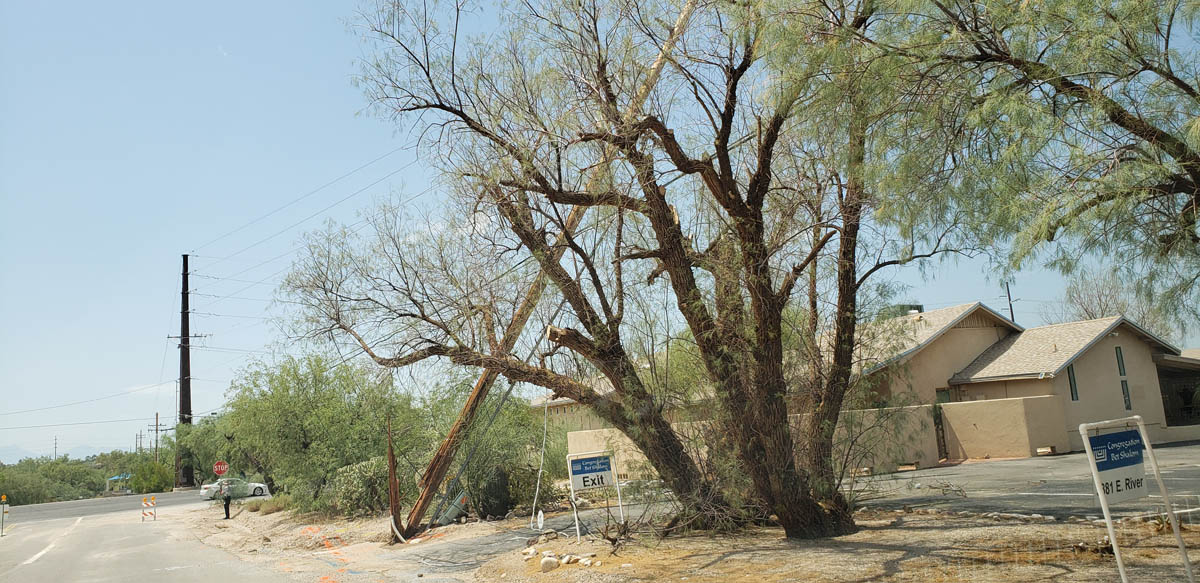
The first pole north of Alvernon.
The one behind on the other side of River Road
is metal and gives a sense of scale.

As if moving wasn't stressful enough, we had two particularly powerful monsoon storms with gusts stronger than we had ever seen.

Weather is always big news. After the polite "How are you?" — which never intends or elicits a real answer — the most common subject of polite conversation has to be the weather. "Lovely weather, isn't it?" When the weather gets a bit extreme, some of us reflect upon climate.

We are only in our seventeenth year in the Old Pueblo. Witnesses who have spent a lifetime here tell us how monsoon season used to be regular afternoon downpour. Nowadays, the afternoon clouds still gather but only occasionally do we actually get rain. Rain here is typically preceded by a vanguard of strong winds. The two monsoon windstorms we experienced last month are beyond anything we have seen. We are getting less rain overall, but more extreme weather.

A utility pole torn into toothpicks.

We were driving back home to San Simeon on the afternoon of July 17th when the first one hit. There was a big traffic jam on eastbound Skyline Drive. The traffic lights at Campbell Avenue were dark. Power outage. An extremely busy intersection had become a four-way stop. After about a half an hour we got through to Sunrise Drive and saw a half mile of devastation: scores of huge palo verde and mesquite trees broken, some completely uprooted, even saguaros, bus stop benches and commercial pylon signs blown away, and standing street signs twisted and deformed.

The only way to get to our house is via Alvernon Way.* The Finger Rock Wash cuts across Alvernon just north and just south of our street. We tried crossing from the north, turned around, tried crossing from the south, and turned around. The wash was dangerously flooded. So we had dinner at the Tucson Racquet Club and a couple of hours later the flood had receded to become a shallow, debris laden stream. We drove across.

There were ten huge and old wooden poles along this part of Alvernon.
Only part of one was left standing
.

We were relieved to find our house still had power, but trees were broken and uprotted all along the way. Not just scores along Sunrise, but hundreds in the Foothills neighborhoods.

Two weeks later, Friday the 28th, the second storm hit. Rain always gets us outside to stare and marvel, but the wind gusts and hail we saw that afternoon were something we had never seen before. At six that evening, the power went out.

Saguaros were broken in two.
The next morning, we drove around. Alvernon by San Simeon used to be lined by ten huge wooden utility poles with wires and cables that ran up the hill from River Road to supply electricity and internet to thousands of residences. The eleventh is a huge metal pole. It remained standing. The ten old wooden poles had all snapped like toothpicks.

We had four days without power. By the first and second day Tucson Electric had restored power to all but thirty-one customers, the thirty-one clustered around our San Simeon Drive where we live at the dead end. We were in the dark until Tuesday afternoon.

At the top of the hill,
the metal utility pole stood its ground.

Inconvenient? People in the neighborhood fled to hotels, stayed with friends, and borrowed generators to keep refrigerators operating. Inconvenient? We are trying to move to our new house as quickly as reasonably possible so we can sell the old. Hell yes, inconvenient. We took a couple of pads and our small television to Dove Mountain and camped on the floor. Thank goodness we already had internet installed.

I read that this year is the hottest in recorded history, courtesy of modern life and our addiction to burning things for fuel. Regardless of the impact on climate, we as a society are unwilling to make changes. We are propelled by "freedom," the profit motive, and vested interests that buy politicians. We are a ship of fools.

Four days later, ten new metal poles.
The cable lines left dangling with a piece of the old wooden pole.


——————————

* Alvernon sounds very Spanish, but it isn't. No one really knows the origin but there was an Al Vernon working for the developer of these parts.

Friday, August 18, 2023

Crossover Dinner & Calories

Last night we had our first home cooked dinner in our new tract home on Dove Mountain. Our very first dinner was about a month ago, a week or so after we closed the purchase. That was take-out pizza so it doesn't count as home cooked, but it was with family which made the gathering particularly special.

CS Road. We know which house is ours because its garage door opens when we press the remote.

Two days ago, Delivery Doctors brought over our heavy furniture, including our bed. I like the mover's name. It's a local moving company with the slogan, "We deliver everything except babies." We had brought over some frozen Bolognese sauce leftover from San Simeon, so last night Shari made some salad, we boiled some pasta and heated the sauce. Presto! Spaghetti Bolognese! A crossover dinner at CS (our abbreviation for our new street, Chaparral Sage).

Delivery Doctors carrying Shari's elliptical.
Backing up that truck in our driveway was no small feat.

Moving is complicated, confusing, discombobulating, exhausting, stressful, unpredictable and expensive. If the new house is a new build, triple the foregoing. The intended benefits from the move are there, but in the process, one has severe doubts. Simple pleasures, like a home cooked meal, even a crossover one, are significant milestones.

Among other expenses, moving costs calories. Every day for the last five weeks we have been driving one or both cars packed with boxes and small furniture the twenty-five miles from San Simeon to the End of the Universe on Dove Mountain Blvd. That's about a forty-five minute drive one way, which is about what our drive from Whidbey Island to Seattle used to take, assuming no ferry line or traffic (highly unlikely). Or, for those familiar with Seattle, the time it takes to drive from First Hill to South Lake Union.

Over three days we packed a fifteen foot rental truck twice. My god how Shari and Stephen labored to help! Then it was time for Delivery Doctors to do the heavy lifting.

Tom's new profession.
Phase I, getting the CS house habitable.

All that packing and carrying burns calories. Each day I stepped on our bathroom scale, I found I had lost yet another pound. Turns out, moving can be a good way to lose weight. My suspicion was confirmed by the three young men from Delivery Doctors who efficiently and energetically lifted refrigerator, couch, elliptical, stacked washer-dryer, beds, dining tables, and the rest of our heavy items, stuffed and tied them inside a truck too big to negotiate our driveway, then unpacked and positioned them inside our new home. Each of the three is muscular and trim. One admitted he eats seven meals a day

I expect to regain some weight but it may take a good many weeks. There is lots of stuff to move before we move into Phase III, getting San Simeon ready for sale. Phase I was getting CS habitable, a never ending process that takes either a lifetime or another move. In this case, the initial adaptations were garage floor coating, painting some spaces so they don't look institutional, installing window coverings, and a new fridge. Phase II is the move. Phase III by itself will be daunting. We will need a dumpster or two just to get rid of downed branches on our little acre from monsoon winds, an aspect of why we are motivated to make this move: too much to maintain.

Still, eating a spaghetti dinner at home is a step on the endless journey towards normalcy — and probably, towards gaining some weight.

Thursday, June 15, 2023

Bobcat & Prey

Our neighborhood bobcat had a good catch yesterday. These videos were captured using re-purposed security cameras. Towards the end, the effortless jump on the wall is amazing.

Friday, September 16, 2022

Peenix Haboob

Another reason not to live in Peenix (there are several) is the weather.

During monsoon season, our state capital sprawl of MAGA nutters gets haboobs: walls of dust blown by powerful winds. The area south of Phoenix is farmland. Lots of cotton. Brush has been plowed up to make nice, exposed soil that is just waiting for 70 m.p.h. winds to blow north into the Phoenix megalopolis.

A haboob blew into south of Phoenix (Chandler) on Friday afternoon, September 2, just as Shari's flight from Everett made its approach to Phoenix Sky Harbor airport, Terminal 3.

Here is some video local media took of the great wall of dust. It's what Shari could see from the airplane.

Fortunately, by the time we collected luggage and found our way out the very confusing and congested Sky Harbor airport, the haboob had blown over.  Good thing because the visibility in a haboob is so bad the only safe thing to do is drive way off the road and turn off your lights so no other car is tempted to follow your lead and rear-end you.

We have a nice new Ford Explorer and its lights stay on for several minutes after you turn off the engine. It's a convenience that could get someone killed.

Saturday, July 2, 2022

Rain Was Not in the Forecast

On Thursday the 10-day forecast was for little chance of rain, a sad forecast because we get three-quarters of our annual rainfall this time of year. Monsoon season.

But Mother Nature had different plans. She dumped some inch and a half of rain within an hour. Some places not that far away got over two inches. Over that one-hour period, the temperature dropped from 103° to 73°.

We had never seen so much rain falling over the edge of the roof.


Thursday, June 2, 2022

One Good Wall Deserves Another

There are lots of nice things about cement blocks. They make great retaining walls that greatly slow down inevitable erosion. They are easier to collect than boulders. They have flat surfaces that can adhere to one another and take stucco. They also can replace inclines lined with rocks and free up those rocks and the occasional boulder for use elsewhere in one's landscape design. And, perhaps the greatest incentive, little critters can't tunnel through them and, if tall enough, javelina are reluctant to jump over them.

So after a few years of loose rocks slipping, critters tunneling, and javelina munching on the roots of ornamentals by my main traversing walkway, I counter-attacked. I made several trips with Agamemnon to Lowes and Home Depot to bring back cement blocks, concrete mix, stucco mix, liquid nails, pea gravel, and clay bricks. I removed my precious native Catalina rocks, dug a trench, and did a rough layout of the wall.

The work is exhilarating and satisfying, although when the lizards are scampering around mid-morning, it's time to get out of the heat. After about a week of early morning work, four or five hours at a time, the block wall was stuccoed, painted, and topped with clay bricks.

I would sit in our outdoor living room and admire not only the pleasing order which I had imposed upon the landscape, but the new areas where I had created terraces with the rocks and the occasional boulder I had freed up.

I noticed something missing.  I had constructed individual lengths of concrete block retaining walls interspersed with natural Catalina rock in our gully (Coat Hanger Valley). I had retaining walls along the slopes defining paths and three sets of stairs leading down to the bottom of the gully, but where you first cross the driveway to get to those paths was untidy. It needed some inviting refinement to entice a person to saunter inside. It needed an entrance.

That required a curve, three test roughed-in layouts, welcome advice from my better half, and a lot of additional trench modifications and cement blocks. The curve was made using three columns of landscape retaining wall wedges between columns of concrete blocks, then filled and smoothed with concrete and stucco.

In my opinion, the result is satisfying. I am almost tempted to have something written out on the curve — you know, in metal letters like universities have their names on masonry curves at the corners of their campuses. Instead of "University of Arizona," I could have "Coat Hanger Valley."

Nah.


Sunday, March 13, 2022

Inspiration

Another morning in the Desert. It's late winter in the Finger Rock wash where I take Nazar the Wonderdog for his early morning saunters.

A hummingbird sits on topmost bare branch of an acacia. A female red cardinal makes its call. I hear javalinas grunting and wait with Nazar to catch a glimpse of the pack. A Gila woodpecker hammers away on a utility pole. A rabbit forages on greens by the side of the road. Doves and a phainopepla sit on electrical lines studying their surroundings. Cactus wrens sit on their adopted saguaros.

I often tell the story of how this city boy, at age forty-seven, moved to the forests of Whidbey Island. For the first time I saw deer, coyotes, rabbits and owls — even the occasional eagle circling in the sky. When we moved to Tucson, I thought living among such wildlife would be a thing of the past. I was mistaken.

I see more varieties of wildlife, and more of them, here in the Desert than I ever saw on our Whidbey Island ten acres. In addition to the variety I saw yesterday morning within the space of twenty minutes, we often see coyotes, wrens, flycatchers, finches, king snakes (we pranam to them), rattlesnakes (we give them wide berth), coachwhip snakes (stunning colors), Gambel's quail, brown and black haired squirrels, ground squirrels, small mice (true masters of tunneling), bobcats, bats, vultures, Harris hawks, owls, jack rabbits, lizards and butterflies of all sizes and shapes, roadrunners, the occasional flight of herons, and during monsoon, toads (unpleasant croaking), tarantulas (scary but harmless), all manner of beetles, and even a desert tortoise. Less common around our house, but frequent in the nearby canyons, are deer, mountain lion, coatamundi, Gila monsters, and bighorn sheep, to name a few.

They inspire me to write.

That same day, my sisters and I took our grand-niece and grand-nephew to the Tucson Festival of Books. The Festival dates back to 2009 and is held on the University of Arizona campus. It started with some 450 authors and presenters, 50,000 visitors, and 800 volunteers. Since then, the visitors have tripled.

We got there before the scheduled opening time. The campus was already crowded. The quad on the campus, several acres of lawn, was covered with hundreds of booths. Our young niece was interested in getting an autograph from one of her favorite children's books authors. We found the classroom in the Education Building and listened to a panel discussion among five authors and illustrators. Nice people. Promoting their books.

They were all nice people. Publishers, hundreds of authors, the volunteers who helped people find their way, and the crowd. It's not easy to become an author accepted by a publisher. You need not only a good book, it has to be in a popular subject matter, you have to find your way through the maze of submittals and agents, and even if you are published, it's still pretty much up to you to promote your book and yourself. Which is why I self publish.

It was a bit daunting to see so much promotion. My morning walks are more inspiring.

Friday, January 28, 2022

Homage to Blue Elves

The funny thing about the blue elf aloe is that it is neither blue (or even a little bit depressed) nor an elf. However, it is an aloe.

The blue elf is a cultivar of the aloe genus which originated in the Old World, Africa and the Near East in particular. Aloes have been grown in the New World for centuries, long enough for one of the five hundred or so aloe species to be named "Mexican" and for the Mexicans to cook the leaves.

No one seems to know who developed the blue elf or how the cultivar got named. They are not blue. If happy (a little shade is always welcome) they are quite green. If over exposed to sunlight or cold, they turn dark, not blue.

They are early bloomers, starting to grow their long stalks and coral colored blooms in winter, even before the aloe vera (the "true aloe") take off. When the regular aloe bloom, it's all at once as if they all had a meeting and unanimously decided upon the opening day. The blue elves tend to be more independent, different plants blooming over weeks and months.

We inherited a couple of clumps of blue elves when we bought the house. I thinned the clumps and planted a few around the gully. I noticed hummingbirds feeding off of the trumpet shaped blue elf flowers. I thinned and planted more clumps.

This winter has been a bumper crop of flowers and the hummingbirds are happy. See for yourself.


Sunday, October 3, 2021

Walls, Roofs & Flower Beds

A parapet is a wall that extends above the roof line.
Our living room has six walls. All six extend to parapets,
as do all exterior bedroom walls.
That's a scupper in the middle.

Of the three — walls, roofs and flower beds — the most damaging was the flower bed. The culprit is water, which by itself is pretty odd given that we live in a desert, albeit one of the earth's wetter deserts.

Walls and roofs are supposed to keep water outside of a house. Well, apparently rainfall in the Sonoran Desert is sufficiently unusual that architects and builders need not bother themselves too much about it. Take our concrete paved backyard and swimming pool apron, for example. They slope towards the house. Come heavy monsoon rains — an annual affair most monsoon seasons — water flooded under the two back doors into the house.

Flat roofs are common here: flatter than your sewer pipe which by code has to slope at least a quarter inch to the foot.

The living room wall where the insulation and framing
were littered with ancient rodent droppings. After
demolition and chlorine, nice and clean
.

Our roof is typical. It is so flat that water puddles with dew even on a clear morning. But hey, coat the flat roof with that white elastomeric polymer stuff. It's very good stuff, actually. But if you read the teeny tiny print on the container, in both English and Spanish, it's not recommended for flat roofs that puddle.

From my observation, my explanation is because it ever so slowly but surely dissolves and erodes the coating. You need a new coat every couple of years, if not more often.

Stucco walls are common here. Stucco covers the stick built frame. Stucco is also good stuff but, like the roof, it needs maintenance to remain water tight. Like many houses here, ours has parapets: walls that extend above the roof. The tops of those walls are stuccoed and they are boundaries between what roofers roof and what painters paint. They are directly exposed to sunshine and weather.

Parapets also have scuppers in them, metal channels to drain rainwater. Stucco (basically, cement and sand), metal (the scuppers themselves) and polymer elastomeric all expand and contract differently. Plus, having reached in myself with a brush generously dipped in elastomeric it's almost impossible to get a good coat inside the six-by-four opening that is twelve inches deep. So you get cracks and gaps.

Parapets, scuppers, and stucco are architecturally pretty. They also can be maintenance nightmares. 

The north wall which was covered with
cat claw vine. Yours truly broke up the
solid line
of masonry that held the
flower bed planter against the stucco
wall. It was this area where Vinny replaced
wall board in the bedroom on the inside.

Then we have flower beds. If you put them next to the stucco walls — I mean the soil rests against the bottom foot or two of the stucco, even above the concrete foundation — you are asking for trouble. That's what the previous owners did, Auggie and Karen, and who knows how many other previous owners in the five decade history of this house. Yes, there is a tar paper lining between the soil and the stucco, but if you do a lot of watering, which Auggie and Karen did, the sprinklers throw water on the walls.

All we knew when we bought the place was there was so much damage to the north side that Auggie and Karen's broker, Vinny "Cover & Conceal" Yackanin, had his slap and dash crew tear out and replace wall board inside the north bedrooms, dig out all the house-hugging flower beds, and replace the soil with cheap one-inch crushed rock.

Vinny also had his crew put a coat of elastomeric on the roof to hide decades of neglect, leaks, and rotten plywood.

Cover & Conceal worked. Our building inspector — a curse on that profession which has never disclosed anything significant to me buying a house — never noticed a thing and pronounced the roof in good shape..

A fascinating footnote. We noticed the stucco outside the guest bedroom (where Vinny had to repair water & mold damage) and the adjacent cement block chimney had been covered with creepers. Remnants of the cat claw vine still hung to the stucco all the way to the roof like ivy on a ruined English castle. That flower bed, like the others, was irrigated by electronic sprinkler system. (When Shari set up our account at Tucson Water, she was told the property had been labeled high use.) Well, that creeper served as a freeway for the rodents to get on the roof and gnaw their way inside the living room walls.

Not a pretty sight even in a photo. The insulation and
the studs on this corner of the bedroom were covered
with black mold. Major wood rot around and under the
window. The corner on the other end of this same
wall has a corner stud three-quarters eaten out by
termites attracted by the moisture. (We had the termites
eradicated some years back.)

That was all covered up by Vinny's roof coat.

We don't know what was planted and watered by the flower bed on the east side outside the master bedroom. Cover & Conceal also had that dug out, but he never bothered to repair the damage to the window and inside the walls.

The good news is the heavy monsoon rains this year caused leaks in the living room, my office, and the master bedroom. That prompted us to work on the scuppers, parapets and roof. More importantly, we had the insides inspected by mold specialists who confirmed the problems. Even more importantly, the mold specialist was so long getting us his estimate, we hired Bear Down Builders (of tower remodel fame) to do the work.

Then we got the mold specialist's seven-page quote, complete with Biblical verse (Corinthians 12:9-10). Admittedly an upside bid, it was $12,000. Bear Downs' estimate was $2,000, although we expect we will go over. We are paying time and materials and we know and like the folks at Bear Down Builders. We want the work done.

The bedroom wall exposed. Nice and clean.
I cleaned up after the Bear Down Builders work pulling drywall nails and bits and pieces of wretched insulation. That would save them some time when the new drywall is installed and it gave Shari and me opportunity to get a close look. Shari donned lab coat, industrial face mask, and thick gloves to scrub mold and spray chlorine bleach over all exposed areas. We have had the rooms breathing and drying with fresh air.

I must say, having the walls exposed and cleaned, we are overwhelmingly grateful to have the work done.