Monday, April 17, 2017

Pascua Yaqui Easter

Like many people, especially those from European immigrant families, I have vivid childhood memories of Easter traditions. They include promising to give up something for Lent, purple cloth covered images in churches, being forbidden music and laughter on Good Friday, painted egg hunts on Easter Sunday, and the Hungarian village custom of boys sprinkling girls on Easter Monday. But, unlike Christmas, and not being a churchgoer or living in a Hungarian community, Easter is not really a part of my calendar. So I was surprised on Good Friday to get “Happy Easter” wishes from work colleagues. I almost replied, “Merry Easter to you,” but played it straight.

Good Saturday we attended the Deer Dance on Pascua Yaqui land. The Deer Dance blends Yoeme tradition with later Catholic influence. Both Yoeme (Yaqui) and Spanish recognized the parallels: weeks of austerity to prepare for the climax of temporary death (the Deer or Jesus) followed by resurrection and salvation. It is a form of spring festival in which the Deer Dance on Good Saturday is a major event. The first Spanish who encountered the Yoeme and named them Yaqui also named them Pascua Yaqui (Easter Yaqui). Spanish Padres incorporated the Yoeme festival into the Easter calendar. The dancing is still done today, in an open sacred space in front of the Chapel of Christ the King in Pascua village.

The Pascua Yaqui Reservation is small. The Pascua village is just south of Tucson and abuts the northern boundary of the much larger Tohono O’odham Reservation. We drove by the imposingly large but neat Casino del Sol, proceeded a few blocks past nicely neat civic buildings, and parked in the spaciously wide and dusty street.

The sacred space was a long rectangle of flat, dusty earth, almost a hundred yards long and twenty wide. Both sides were marked with sprigs of fresh cottonwood (I think) leaves pushed into the hard ground. Framing the sides of the broad public space around the sacred space, were long, continuous stalls that sold mostly drinks and food.

The stalls were painted white and the Pascua vendors hadn’t bothered with signs, Pepsi, Coca-Cola or otherwise. Their plainness matched the tones of the pink earth and the whitewashed church. The simplicity was also reflected by the strict and oft-repeated prohibition: no pictures, no cell phones. To try to use one would have resulted in immediate confiscation and destruction. Pascua Yaqui law was enforced by Pascua Yaqui police, crowd ushers, and pretty much everyone else there. “Take pictures in your mind, your heart, your body,” repeated the friendly voice of the bi-lingual announcer. Also strictly prohibited were alcohol, drugs, and drawing (for those who wanted to sketch the scenes instead of photographing them).

Simple also was the seating. I don’t believe I’ve ever seen so many folding camping chairs in one place. They were three and four deep on both sides. There must have been a thousand people there, mostly local, plus about one or two hundred directly involved in the ceremony. The local population is only four thousand.

Ceremony. Dance. Ritual. Festival. Pageant. There is no one good name that describes the wonder that we witnessed. It has roots in the origins of who we are and the Yoeme belief that the ritual dance helps maintain the balance of good in creation. It was also family-friendly, all in one. And what we saw was only a tiny part of the whole that unfolds over weeks. The dancers we saw had been dancing for days and weeks.

The Pascua don’t talk about it. Like no photographs, they prefer the direct experience. Even those who work for the tribe don’t get explanations. Our connection to the experience, let's call him "Bob" to protect his identity, told us that when he would ask the meaning of some part of the event, he would get the response, "I would have to ask grandfather." It was a polite brush-off. Still, Bob had pieced together some of what happens, and there is enough scattered on the internet to shed some more light.

What I saw was long formations of men and some young teenagers dressed in black with purple or red trim, brandishing what looked like wooden swords painted black with red and white details. Most had black cloth around their heads and hats, covering their faces. All wore simple leather sandals and many puttee-like leg wraps, their feet stepping, stamping and shuffling in unison to the beats of wooden knives on wooden swords. All had crosses on their black robes; a protection for the dancers, just in case. These were the Chapayekas, the demons or otherwise bad spirits. Converted to Christianity in the 17th Century, the Chapayekas of the Yeome became identified as the common soldiers of the Fariseos, masked characters wearing elaborate costumes with fantastic, sometimes grotesque shapes. Some Fariseos looked like pink skinned, bearded Anglos. One of them had a top hat and carried a book. Others looked like a clown or a contorted pig. They were the Pharisees.

When we arrived around ten in the sunny morning, a donkey had been hanging around the front of the church with its young cowboy rider. Over an hour later, as the procession of Chapayekas entered the space, the donkey had become the bearer of the idol worshiped by the demons. The idol was Judas, an effigy figure of a man held up on the donkey on either side by a man with a stick. The procession was  accompanied by the rhythmic clicks of wooden daggers and swords and the sound of scores and scores of sandals shuffling in unison on the ground, slowly and energetically.

Slowly the black robed Chapayekas and magnificently hideous Fariseos paraded down one side of the space, but only as far as a broad white line of chalk in front of the church, than back the other side. The lines of dancers continued outside the space and disappeared. Bob told us they proceeded around the town. They were the bad guys proudly parading Judas because Jesus had been killed the day before, on Good Friday.

The Lenten activities of the Pascua Yaqui are organized by societies. Some are the singers and chanters, others perform the role of Chapayekas and Fariseos, and there is, of course, the Deer Dancer Society. After the initial parade, some of the Chapayeka and Fariseo participants returned with gourd bowls to collect donations from the audience.

Sometime later (we were on local time, which passes on its own schedule) we spotted the Deer Dancer getting ready in the space in front of the church protected by the white line. With him were older men dressed in colorful and glittering cloths. They were angels. They all wore rattling shells on their legs.

Gently, timidly, the Deer Dancer began to dance, moving like a nervous deer looking to graze.

In front of the church were lots of folks, regular folks; the faithful, if you will, who also played in this Easter Deer Pageant. They had a big canvass full of fresh greens. The Deer Dancer timidly danced towards the canvass, then partook of the greens that were offered.

The Chapayekas and Fariseos returned, always staying back from the line protecting the church, the Deer, angels and congregation on the church side. A bad guy dressed as a hunter came forward to the line and shoots several arrows at the Deer and seemingly killed it. Then demons and archer rhythmically paraded back out. The Deer somehow just got up. (I didn’t quite get an understanding of that part because I thought resurrection would be more dramatic.)

All this time the audience was behind the cottonwood sprig-demarked lines on either side of the sacred space. Scores of minutes passed. The crowd got bigger. It seemed as if everyone was drinking sugar drinks and eating tacos, fried chips, ketchup, and Navaho fried bread purchased from the food and drink stalls. The locals mostly carried on as if at an extended family picnic, iced coolers, camp chairs, fidgety kids, and all. From snippets of conversation, it was obvious that many were related or knew one or the other hooded or masked participant.

The announcer advised that the celebration was about to begin, but tens more minutes passed as the participants prepared. Meanwhile, those in the crowd armed themselves with baggies full of homemade confetti.

The demons returned. I don’t know what happened to the idol on the donkey, but some forty minutes later, the fate of the idol became obvious.

The columns of black demons led by the masked ghouls paraded, more like danced, two-thirds into the space to the beat of sticks and the shuffle of feet. They slowed, almost to a stop. The angels by the Deer were shouting at them, perhaps taunting the demons. They were joined by the congregation. Finally, the demons had enough.

The lead Chapayekas gave the signal and the demons rushed the white chalk line with a shout. Pandemonium broke out. Yells, shouting, sticks on sticks, firecrackers, blank shots from pistols, and exceedingly powerful explosions of firecrackers, all accompanied by the audience throwing confetti.

(Originally, the confetti would have been flowers. Yaquis consider flowers as one of the four worlds, the others being animals, people, and the dead. Significantly, the Deer Dancer’s antlers are decorated with flowers.)

Three times this happened. Each time the formation of ghouls and demons approached to a different and increasingly faster beat of sticks and shuffle of feet. Each time the demons paused, the angels taunted, the deer grazed, and then the attack. Each rush was a din of mock fighting, drums, shouts, firecrackers, blank shells, and sudden explosions so loud that the body vibrated. Each time the demons were repulsed at the line.

After the second unsuccessful attack, some of the folks in front of the church ran across the line to the far end of the space where the demons had retreated. There the they took the black robes and masks of some of the demon group. After the third change, all the demons had taken off their black robes, dropped their wooden swords and knives, and rushed into the church.
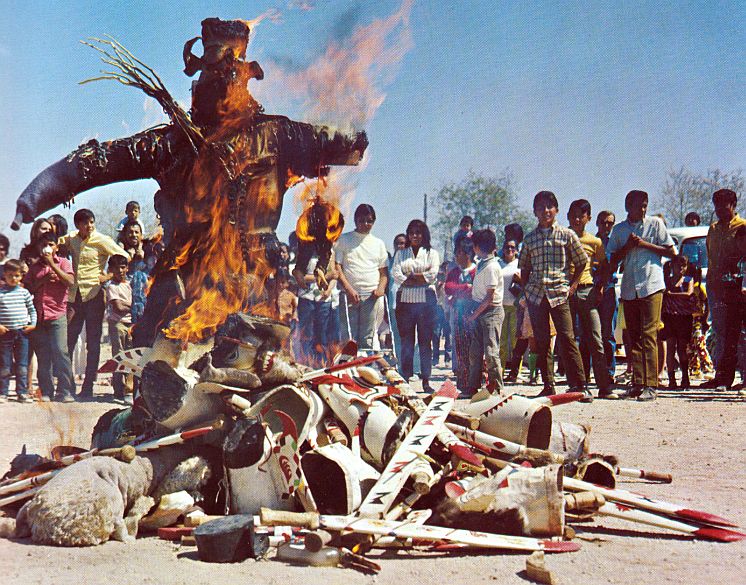
Bob explained that the demons had been converted. Their wooden swords, masks and idols were burned in a big bonfire. Indeed, I had noticed stacks of mesquite firewood and the Pascua Yaqui Fire Department trucks positioning themselves on the street on the very far side of the space. As the audience dispersed and we left after the mass salvation, we could see the smouldering frame of the Judas effigy and pieces of painted wooden swords still burning in an intensely fierce fire.

The participants had entered inside the church where, in another part of the ceremony that is private to the participants, Bob explained, those who had played the roles of Chapayekas and Fariseos received blessings and absolution.

The Deer is not Christ literally. The Deer and what we experienced have a much deeper meaning.

Wednesday, April 5, 2017

St Anthony's Monastery

St. Anthony's Church, the main church at the monastery.
"[T]he Orthodox Church makes no sharp distinction in its worship between the spiritual and the aesthetic. One becomes aware of God's presence through the senses, in the experience of 'splendor' and 'beauty.' . . ."

"This emphasis on sensory involvement has its basis in the Orthodox and thoroughly Biblical conviction that it is the whole world, and not only man's soul, that will be transfigured - 'saved' - when Christ establishes His Kingdom at the end of time."

Greek Orthodox Diocese of America website:

Visit an Orthodox church and you will see a vision of heaven on earth. Visit St. Anthony's Greek Orthodox Monastery and you will see at least six visions of heaven on earth, each a different variation on the Orthodox theme.
 ——— ∞ ———
 
The iconostasis of St. Anthony's, the wall of icons
that separates the Holy of Holies from the main church.
My connection to St. Anthony's Monastery is Shari's Greek language tutor. That connection was made through the local Greek Orthodox church in Tucson, St. Demetrios, and its annual Greek Festival. The tutor visits the monastery every other weekend.

Six monks from Mount Athos in Greece lead by Elder Ephraim established St. Anthony's Monastery in the desert just south of Florence, the Pinal County seat. That was in 1995.

The area around Florence is lowland Sonoran Desert. What historically used to be the Gila River, free flowing most of the year, has been dammed for almost a century so now it is almost always dry. Creosote bush, cholla, sage and hardy small hedgehog cacti grow there, with the occasional palo verde tree. The lack of river flow coupled with bore wells extracting water from aquifers means the water table has dropped from ten to a hundred feet below the surface. It is in this arid environment that the monks purchased land.

The monastery land without irrigation. On the hill top is
the newly completed chapel in honor of St. Elijah.
Getting the necessary permits from Pinal County was not a problem, but planners, sheriff and other County officials were puzzled because the land had no water. They discouraged the monks but the monks were not deterred.

The land was purchased and Elder Ephraim identified three areas to drill for water. Wells were dug in those places and water found.

Elder Ephraim spends many hours each day in meditation. Apparently, he knows a few things.

 ——— ∞ ———


The wells supply abundant water, as evidenced by at least ten acres of date palms, orange and olive groves, lush gardens with tall fan palms, paved walkways, and some half dozen fountains and courtyards.

The physical development of the monastery in a scant twenty-two years is nothing short of amazing. The monks lived in trailers as the buildings were constructed with generous donations and volunteer labor.


There is the main church (St. Anthony's), three other free-standing churches (St. Nicholas', St. George's, and St. Demetrios'), an open chapel in honor of St. Seraphim, plus separate buildings for monks, nuns, guests, meals and visitors. The community has grown to forty monks and novices.
 
The site is truly a feast for the senses.

Each structure is impressive. The design, materials, woodwork, metalwork, hardware, and every other imaginable detail of the churches are all impressive. The only electric lights in the churches are two reading lamps at the chanter's stand. Ornate and huge metal chandeliers are suspended under the central domes of each church. During services, the churches are  illuminated by candles and oil lamps.

The icons are awe inspiring, which is the intent according to Orthodox tradition.

Many of the icons were created in Greece. There are scores and scores. Much of the woodwork was carved in Greece. The churches are richly decorated with ornately carved wood frames. Even the wooden doors are gorgeous and precisely fitted.

To add to the glorified beauty, the churches and other buildings are set in a well laid out in a shaded environment of palm-lined walkways, lush orchards and flowering gardens, and delightful fountains.
 ——— ∞ ———

A feast for the senses. Orthodox Christianity, even more than the Roman, extols the beauty of creation with representations of saints and the divine. They are human forms and faces; stylized, but very much human.

Inside St. George's, a church constructed in the Romanian style.
The woodwork is detailed, precise, and prolific.
The human image in religious expression is strictly forbidden in Judaism and Islam. There is stunning geometric beauty in the mosques I have seen in Egypt, Jerusalem and Turkey, both in the overall design of the spaces and in the intricacy of their adornments of filigree, tiles and Arabic script quoting the Koran. There is no human image.

Then there is the stunning, human beauty of these Orthodox churches.

Each religion is making a statement about Spirit: one is that Spirit cannot be depicted; the other that Spirit pervades creation. Both are correct, in my view, but my preference is to recognize Divinity in creation and in humanity.

I believe that everything in creation is only an appearance, an expression or a symbol of Spirit. I believe only Consciousness exists, and we live within an expression of that Consciousness. Our world in its enlightenment is actually very beautiful.

Somehow, beatific images with human faces make me humble. I can relate to the image because it is similar to my own. If some human faces can be elevated and sanctified, then perhaps we all share in that possibility.

Put it another way. It's hard to be a jerk when confronted with beautiful images that remind us of who we are (or should be), and particularly images of the Divine Mother in the form of woman and child.
 ——— ∞ ———

The dress code is not perfection and some of the practices are depressing. Monks are severely dressed in black. Women must be all covered with long dresses and sleeves, closed shoes, and head scarves. I visited in spring when the desert is blooming in contrast to the Christian practice of Lent which is inherently somber. (Unlike Roman churches, the icons were not covered in purple cloth.) By the time I was leaving, believers had gathered in the entrance hall of St. Anthony's to have the priests hear their confessions. An odd practice, but I suppose they feel better afterwards. And don't get me started on the books for sale in the bookstore. I am not a great fan of religious dogma. Still, the stylized dress code and religious practices serve to impress a sense of humility and respect. More importantly, one cannot complain about the friendly, cheerful, even devotional disposition of the residents, guides and believers at the monastery. That made even the tourists behave nicely.

Thing is, I did not even have a full experience. That would include not only the beautiful space and its icons, but the illumination by oil lamps and candles, the fragrance of incense, the divine sound of musical chanting, the liturgical drama of the opening of the Holy of Holies and the sharing of communion, and experiencing the elevating energy of the participants' devotion.

Thursday, February 16, 2017

Non-Linear Editing and the Compression of Time

Editing video on a computer used to be called non-linear, as distinguished from editing on film media, or even running one VCR and recording on another. Using two video tape players was how I began video editing. Non-linear means one can assemble and re-assemble an edit in any sequence. Those were the days, about a decade ago, when I plunged into editing video on a computer.

Since then, we got high definition consumer video. Time passed by my mini-DV tape camcorder, my Apple G5 computer, and the state-of-the-art Apple Final Cut editing software on which I edited probably fifty to a hundred different programs. I stopped taking video. I put off upgrading to high definition knowing that it entailed a new camera, a new computer, new editing software, a Blu-Ray drive, new DVD and Blu-Ray authoring software, and the learning curves to figure them all out.

Four months ago, my niece asked me to videotape her wedding. I took the plunge and bought a new high definition camera, the subject of an earlier blog post. Fumbling with its controls, I managed to get about an hour and a half of video. Returning home, I thought I would go back to Windows since I already had a relatively new Windows laptop. My first non-linear editing program, way back when, was Adobe Premiere on a Windows machine, so I thought I would give the current version, admittedly, the basic Elements version, a chance. That proved too frustrating, so I decided to return to Apple editing. Hence my new iMac and the current Final Cut Pro X.

Technology has changed in a decade, much to my frustration. I used to be able to assemble an edit from multiple clips in a few minutes. That was non-linear editing. Now, the powers that be at Apple have created a "magnetic" timeline which cannot be turned off. It automatically inserts, arranges and shifts clips. What used to be non-linear has reverted back to linear.

That is the state of today's software. It's too automatic. Fortunately, I found a YouTube video showing how one can fill the magnetic timeline with a slug then proceed to non-linearly assemble clips.

Edits done, I proceeded to use four different DVD authoring programs (three on the iMac and, after transferring huge files on a thumb-drive, one on my Windows laptop) and various different settings to burn DVD's in about a dozen different ways. I felt like Thomas Edison experimenting with hundreds of different materials for filaments before he came up with a working light bulb. High definition my foot. Different burns competed with each other for the most miserable picture quality, complete with pixelation and artifacts. I began to get depressed about the project and put it aside.

I thought to myself that perhaps I should just stick to a Blu-Ray product. I burned my first Blu-Ray disc and, thank goodness, the picture quality on our television was gorgeous. The thing is, we hardly ever use our Blu-Ray player. Even when we rent videos, we go for DVD instead of Blu-Ray. There are two reasons. First, we only have two HDMI (high definition) input plugs in the back of our television and they are used for the DirectTV dish and for AppleTV (i.e., Netflix). I tried using an HDMI splitter, but it doesn't work on our TV. I am not going to buy a new TV just to get an extra HDMI input, and reaching in back of our existing TV with a flashlight to switch connections is a pain in the neck. The second reason is that DVD quality looks very nice on our big TV, almost as good as Blu-Ray.

In my technological malaise, I thought maybe I could transfer my edits to my old Mac. After all, both machines are Apple products (although my G5 is pre-Intel chip). To cut what is already a long story a bit shorter, here is what I had to do: (i) I exported (the current terminology is "share") my edited product by converting the 1080x1920 resolution to 720x480 DV, being careful to not to chose the anamorphic version. Anamorphic was my first attempt and the image was squashed a bit. I hate squashed video images. (ii) Because a 64 Gbyte thumb drive that works on a new iMac cannot be read by my old G5, I copied the humongous file onto my Windows laptop. This was the key to my success. (iii) I reformatted the thumb drive to the old Windows NTFS format, then copied the humongous file back onto the thumb drive. (iv) I loaded the file onto my old G5. Oddly enough, it worked.

Now for the second punchline. I have already exposed the meaning of the "Non-Linear" title to this post. The other theme to this story is the value of patience. It takes a lot of time to compress a video file so it fits onto a DVD. If it is done well, it means going back and forth several times sampling the individual frames to know where pixels can be compressed. The more movement in the images, the less compression.

If you look up comparisons of DVD and Blu-Ray authoring programs on the internet, you will notice that the reviewers place considerable value on a software's ability to do it quickly. It took only about a half an hour, maybe forty-five minutes for all my previous DVD attempts to compress and burn. Every product was wretched. On my old G5 Mac and its good old iDVD software (the freebie and sophisticated DVD authoring program that is no longer supported by Apple or even capable of running on new Apple machines), it took about six hours.

The product? Very nice, thank you. One ought not sacrifice quality for time.

Jumps & Spins, the Video

The deeper technological and philosophical question is preservation. What formats and media will survive the passage of time? Over the course of a scant decade, optical media have become passé. How does one watch video nowadays? YouTube? Smart phones? What about the future? In the world of still photography, JPG and TIFF files are reasonably universal, but there is no such standardization for video. [Witness my frustration getting two video clips visible on this blog post.] How can we archive video so it can be enjoyed decades later?

 
8mm film from Australia, about 1965

Does anyone have an 8mm movie projector?

Thursday, January 19, 2017

Extreme Weather Warning

I'm organizing photos on my computer and a pop-up pops up. It's a winter weather warning for my area, Baja Arizona. The threat is rain.

True, we had about an inch over the last weekend. Ground is still damp after a few days of sunshine. The forecast is for a few days of rain. Apparently, that's cause for a warning interruption.

We do get rain in the winter. It also gets cold. It's about 56F now, about the same as the water in the swimming pool in which I just dipped. It will get into the low forties late in the night. That's cold for us, but it's not like anything to worry about.

It's fantasy news. Some idiot program, written by some profit-oriented business, hypes reality for the sake of visibility. Winter rain is seasonal. No one needs a warning. If one is doing something for which the weather is relevant, one looks it up. Otherwise, winter rain will not kill you. But news and weather are business. So this idiot program interrupts my computer to warn me about winter weather.

Thursday, October 13, 2016

I Don't Like It, but

"It's your mantra," jokes Shari.

It is my mantra. I sing the line so often, at least once a day, many days more often, "I don't like it but I guess things happen that way. Ududbadub, ududbadub."

It's from a Johnny Cash song, Guess Things Happen That Way.

Wednesday, October 5, 2016

The Camera Bag, Seattle Airport, and the Wedding

I was introduced to my niece's fiancée, Caleb during Shari's and my recent short visit to Seattle. Stephanie, my niece, asked me to videotape her wedding ceremony. Of course, I was flattered. The wedding was scheduled two weeks later and one week after Shari and I had already planned to return to Tucson. So I had bought a ticket to return to Seattle the following week for two nights so I could attend the wedding.

By the time I got back to Tucson, I had only a week to buy a new video camera, figure out its basic operation, and mail order an extra battery, charger, and camera bag. I should have spent some time learning the basics of how to carry the bag.

Only two nights in Seattle, I traveled lightly. I boarded the plane with a small, wheeled and draggable carry-on and my new little camera bag. The new fangled, high definition video cameras are extremely petite and light. I removed that little bag's flimsy shoulder strap —  it was more of a nuisance than a help. Its hand strap worked fine, a bit like a man clutch purse. The little bag, stowed beneath the aircraft seat in front of me, also served to hold my wallet and wireless phone, cautiously removed from my coat pockets because I shoved my coat in the overhead bin.

I'm still getting used to using my wireless smartphone. I get nervous when it makes its little sounds because, like a baby crying, I'm not sure what it wants me to do. Plus the protective cover I bought for it has a flap that covers its screen, so it's a bit cumbersome to use. But use it I did on my flight to Seattle.

I did really well. I even used the Alaska Airline app to create a boarding pass with the "QR" (square) barcode on my phone screen. Just in case, I had a printed paper boarding pass and kept it in my coat pocket, but I bravely fumbled and exposed my phone underneath the boarding scanner; several times, actually, because I had a hard time believing it worked. "Am I okay? This is my first time using this." She smiled faintly and I proceeded into the jetway, dragging my carry-on, clutching my camera bag, and fumbling with my smartphone.

Two hands and three things. Like chewing gum and walking at the same time. I already knew that if I wanted to use my phone on the go, like people everywhere do, I needed a way to strap the camera bag onto the drag handle of my carry-on. I mentally decided to jury-rig something for the return flight.

Fate deigned to impress that resolution deeply into my psyche.

"Airplane mode", some Kindle-book reading, and a lot of solitaire got me through the flight. Seat belt signs extinguished, I retrieved jacket and carry-on. Very deliberately I removed phone and wallet from the camera bag, turned "airplane mode" to "off", and put the two items in my inside coat pockets.

I was doing fine until the phone made one of its little noises as I was walking up the jetway. I had no desire or competence to field a phone call or text while disembarking in a narrow tunnel — or even just walking in an airport crowd. I fumbled with the nuisance and, mercifully, accidentally swiped it upside down, turning it off.

Those familiar with smart phones know how to swipe right to answer and left to hang up and leave the caller with the "please leave a message" prompt. I had my smartphone several weeks before I figured that out.

I didn't want to block any of the many streams of human traffic armed with clumsy baggage, so I walked towards the nearest blank wall, put down my two bags, and reached for my phone.

It had one text message from Shari forwarding a photo of our niece Jessica suckling her newborn, Lila Marie, born while I was in flight, born a week and a half past due and after a day and a half of painful labor. Over the previous days, Shari had shared periodic text message reports from Jessica's mum who was in attendance. Delivery required an emergency C-section, but the smile on Jess's face in that photo was a precious relief to me. And the first distraction.

My phone also had two voicemail messages. My sister Cini called to let me know that sister Böbe would pick me up. Böbe called to let me know she was already waiting. I called Böbe to let her know I was off the plane. Even as I pushed the red phone icon (the shape of an archaic phone handle no longer in general use) to hang up, I mentally patted myself on the back for being so tech-savvy.

I briskly walked through the North Satellite, down the escalators, onto the connecting train to the main terminal (knowing not to get off at C-concourse), past baggage claim and out the exit doors to the street where I saw Böbe and her blue Honda about a hundred yards away — I felt smugly competent. Heck, I knew that airport.

Then I realized I didn't have the camera bag.

Time slowed down as I realized I had left it somewhere.

I had to go back and retrace my steps, I thought, but TSA would never allow me back into the terminal.

Poor Böbe, with a startled smile mixing welcome with confusion at my agitation, took my carry-on as I blurted out that I'd left my camera bag behind. I turned and fairly ran back inside the baggage claim area. For the next half hour or more I telephoned her periodically to give status reports as the drama unfolded.

First I went to the Alaska Airlines lost baggage desk. They were helpful to make some calls, take a description, and explain how, if I had left it on the train, I'd have to check with the SeaTac Airport police. The police have their own lost and found and, the Alaska employee suggested gravely, it was harder to claim stuff from them. She pointed me towards the nearby police counter.

I was pessimistic. I was thinking I'd have time in the morning to buy a replacement camera. I was in disbelief of how careless and distracted I had been.

There were two uniformed officers inside the protected, glassed-in counter. I located the open window and explained my situation to the woman officer; awkwardly because she was sitting by a computer to left and inside of the window. The man officer sat on a desk on the other side and just listened.

I explained my theories of where I might have left it, likely at the North Satellite but possibly on the train. I was certain I had it with me as I walked off the airplane. I thought it was black, but it could have been dark blue. (I couldn't remember.) It was small and the only identification was my printed Alaska itinerary folded up inside.

The more I explained, the more helpless and hopeless I felt.

"When was this?"

"Maybe twenty minutes ago."

"Which gate?"

"I think N-3. It was the Alaska flight from Tucson."

She calmly looked it up on the computer. It was gate N-4.

She located the security camera and found the time in the recording when they opened the door to the jetway. The time stamp read three-thirty. I was leaning inside the window and to the left as she turned the screen towards me. She said, "It's on fast. Each minute is actually seven in real time, or we'd be here for an hour." She remarked to the man officer that the Alaska folks had opened the gate very early.

"More time," I thought as my sister Böbe waited outside.

It was a security camera in the jetway that faced towards the terminal. We would see the backs of passengers as they filed underneath.

It took forever. I made a phone call to Böbe waiting outside, a combined status report and apology. I told the woman officer that we had disembarked around four, but she let the recording play from three-thirty.

I couldn't understand why she was focused on the jetway. I knew I had it with me there. I supposed it would confirm that I didn't leave it on the plane.

"I walked inside the terminal past one or two other gates to a blank wall where I could stop and field some phone calls. I think that's probably where I left it."

Minutes passed agonizingly slowly as we watched the empty jetway with the occasional Alaska employee walking through. More time for someone to pinch my bag.

"Did you have the bag on a shoulder strap?"

"No." I'd taken it off and had held it by a short handbag strap.

"What color pants are you wearing?"

"Light tan," I said stepping back from the window and looking down. I realized that sitting in her enclosure, she couldn't see my bottom half.

"Shoe color?"

"White tennis shoes," I said, again looking down to make sure.

More minutes passed in real time, many more in virtual time. Sure enough, the backs of passengers started passing under the camera. I awkwardly leaned in the window and to the left to make out the images on the screen that was a bit too far away from me. My job was to recognize me.

There I was. I was a bit surprised at the paleness of my figure: white hair, light colored jacket, light colored pants, and white shoes. I thought I should have chosen more color and variety for my ensemble. I had dressed in Tucson sunshine but here I was in the dark grey of the Pacific Northwest. My light shades didn't suit the grey environment.

The security camera recording showed me pulling the carry-on with the right hand, the small camera bag in my left.

Okay, I thought. I didn't leave it on the plane. Maybe now I could cut my losses, leave my name and number, and go.

She kept looking at the computer screen at slow playback. It showed me walking into the terminal. Other people got in the way, but we could see a blank wall space in the image, on the other side of the adjacent gate. Somehow, the angle of that camera in that narrow jetway included that blank wall space maybe thirty or fifty yards and crowds of people away.

The little camera bag; tennis shoes for scale. A re-enactment
to show how small it is. Imagine it by the wall of
a crowded, hectic major airport terminal.
She zoomed in a little, but the image got blurry quickly. I wanted to crack a joke about the unreality of computer enhancement on CSI and other TV shows, but in my agitation, I couldn't remember the name of any high-tech detective TV show. But every time I could, I complimented and thanked her.

Through scores of other passengers passing between the camera and me, we could follow as I walked up to that blank wall space, camera bag still in my hand. I stopped. More scores of intervening passengers later, my pale, ghost-like figure walked away and out of view. It took a little more time to confirm the remaining image. Sure enough, left behind on the ground was a small dark object.

Now, maybe, my risk was that someone had pinched it, or someone had turned it into lost and found where it could remain lost in the system for hours, days, or even forever.

We kept watching the screen as passengers and airport employees passed by. Then the jetway doors closed. The show was over.

I think by then that the woman officer had sent the man officer off to check on the train. She dialed him up on some wireless phone-like link, or got a call. I really lost track. But she did get a confirmation that the bag had been recovered and the man officer was bringing it back. She told me to call my sister, who had been waiting in a nearby parking lot, to come back outside to the arrival pickup area.

As we waited for what seemed to me a really long time (I thought to myself, had he stopped for a cup of coffee?), she explained how this surveillance camera work on my behalf was good practice for her. Only a few officers in the force knew how to work the computer application. She told me that she had used the system and some if its hundred or so cameras to identify, track and capture a murder suspect trying to flee the country.

She also told me that the previous day she had worked the arrival curb area and how much more difficult that was: standing on her feet and having to tell less than cooperative people they couldn't park and had to move. SeaTac is a very congested and busy airport. She walked outside to check on my sister's blue Honda, again parked by the no-parking curb, then called the officer on duty to tell him or her to let that Honda be.

Finally the man officer returned carrying my little black bag. All too quickly I thanked both officers, then ran out the automatic doors and towards the blue Honda. I barely remembered to say hello to Böbe as I sat in the passenger seat and apologized for my carelessness and delay.

As we drove off, I remembered something else. "Say, is my carry-on bag in the car?"

Friday, August 19, 2016

Bond

It's always good when a new James Bond movie comes out. The movie channels play the old ones back to back. There are twenty-six so far. That's happening now, which is in addition to BBC America's periodic Bond evenings.

We like James Bond movies, particularly the older Bonds: [Sir] Sean Connery, of course, is tops. Pierce Brosnan, even Timothy Dalton, are great. [Sir] Roger Moore, who played Bond most often, is passable, but the franchise is loosing some of its innocence with Daniel Craig. It's not that Craig is a poor Bond, au contraire, but the movies have gotten darker.

Most movies, even the ones I like, I don't care to see again. The genre is different from music. If I like music, I'll play it often. With movies that depend on plots, once you know the ending, that's enough.

The Bond franchise, in the main, is different. Each improbable scene with its unlikely gadgets and escapes is a mini-movie. Great sets, on-location filming, beautiful costumes, and a constant thread of light humor make even the chase scenes fun. It's eye candy, light, with fantasy and a cast of comfortable characters because you know the good guys and the bad guys get the appropriate ending.

Escape is a major reason I watch movies. Unless the subject matter is something I want to learn about, I prefer escape. Each movie, after all, is another person's creation of a dream. Why would I spend time with someone else's dark dream? Brutality and endless tension are dark.

Bond films, like Star Trek Next Generation (also a weekly marathon on BBC America and another welcome opportunity to escape), and their characters somehow do not lose their charm and keep a sense of lightness, fantasy and even idealism.