Thursday, July 10, 2014

Monsoon Rain - New Growth

We've had something like one to two inches of rain over this last week. Down the hill a rain gauge reports an inch; up the hill another rain gauge reports two and a third inches.

Rain is like that here. Go a few blocks and it can be very different. Check out the Arizona rainlog website.

One can tell the plants are happy. And there are surprises and miracles.

So I'm pulling the recently emptied recycling container back from the street and notice a pin cushion cactus by the side of the driveway. It's in full bloom. It all happened overnight. Pin cushions are tiny cacti, as you can see from the ruler posing next to it.

I had to take a photo and share the beauty of these tiny little plants that like to hide in the shade of sagebrush.

Other vegetative responses are more common, but no less miraculous. There are palo verde seedlings everywhere. What is amazing about the sprouts is how they move the dirt around them. I would need time-lapse photography to capture the movement, but each seedling has pushed dirt and small pebbles aside to create a little depression around itself.

How do they do that? Plants aren't supposed to move like that, are they?

Friday, July 4, 2014

The Desert Smells Like Rain

 Rain.

The shock of humid air and the smell of the first wet after weeks of summer heat are among the most exhilarating and dramatic sensations in the Sonoran Desert.

We've had three-digit highs and clear skies for weeks. Wednesday night it rained enough that everything smelled heavily moist on Thursday morning. More clouds gathered in the afternoon and the desert got a decent drenching.

It's like a blessing. It's like an incredible act of kindness.

I've been on a weekly schedule of watering plants and trees. I feel responsible for anything I've planted or transplanted, and it's taken some time for me to realize that the bigger agaves, palo verdes, acacias, and even eucalyptus need occasional water to thrive. "There's not a plant in the desert that doesn't like water once a week," said the nurseryman down the street who has a gardening talk show on the radio.

It's one thing to try to flood the roots of a plant with a garden hose. It's another when Nature floods the landscape.

It's an amazing display of generosity. Rain falling everywhere — on ornamentals and weeds alike; petunias, sage, creosote, and saguaro.

Monday, June 2, 2014

The Great Fence of San Simeon

On Saturday, May 31, 2014, the Great Fence of San Simeon was completed.

As the last gate was being covered with hardware cloth to complete the compound enclosure, sure enough, a large lizard had wandered inside and was unable to tunnel or climb out -- a good indication of the value of the fence.

We have nothing against lizards. They eat bugs. I teased and chased it out with a piece of PVC pipe and the garden hose.

Which reminds me of the great walls that we humans erect to keep our kind in and the other kind out. Like the Great Wall of China, the Berlin Wall, the Israeli West Bank Wall, and the other great fence in Arizona that we justify in the name of Homeland Security.

Then we have the walls we build in our minds, like Fox Noise and MSNBC. But enough of comparing people with varmints.

We hope to invite many people into our new garden. And they will also be free to leave.

Our great fence isn't a wall to divide people against each other. It's a fence to keep out rabbits, rats, chipmunks, squirrels, and javelinas.

Odds are, the smaller mammals can climb the fence, and we'll need bird netting for when anything gets close to being ripe, but the fence does give a sense of insular protection.

Perhaps it's a false sense, like the great rabbit-proof fence of Western Australia.

Still, it's an aesthetic of what can be done with an long and heavy iron pike, lots of skin-piercing aviary wire, nasty treated wood (warped as they are), ready-made (thank God) metal gate frames, a rake, concrete and plastic ties.

My work is largely done, although paths to two of the gates need improving. Now it's Shari's turn. She gets to turn the desert into a vegetable paradise. So far, she loves the morning watering of her little green babies.

Tuesday, May 27, 2014

Gates with Thresholds to Nowhere

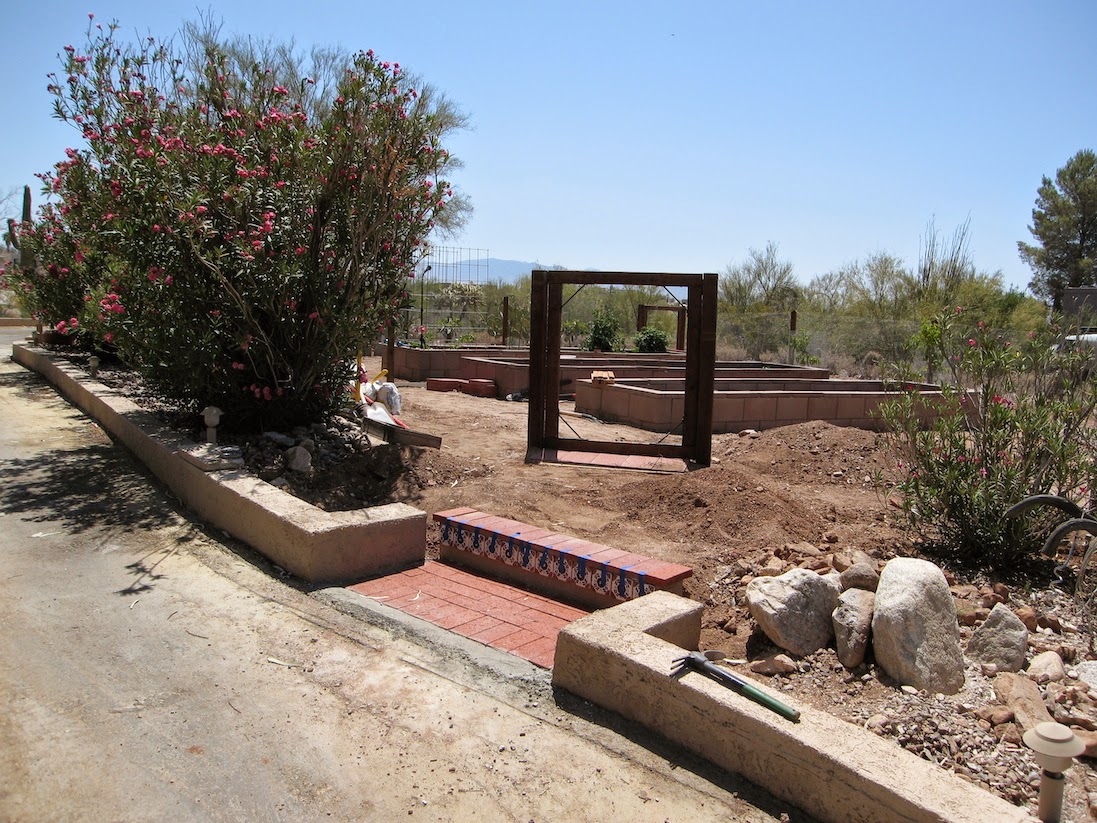
The newest curb cut makes the garden entrance more inviting.
It was a delightful long weekend spent working on the new garden. The three gates to nowhere got concrete brick thresholds so they shut and seal along the bottoms, the last two post holes were dug and the posts embedded in concrete.

My favorite work was Saturday. Three concrete blocks were chiseled out of the driveway curb, and irrigation water lines and landscape electricity lines re-routed to make way. Digging two trenches resulted in relocated sprinklers for the oleander and a new, strategically located garden faucet -- my seventh.


Then two blocks were set facing inwards, paving bricks laid, a step to nowhere created, stucco repaired and painted, and some decorative Mexican tiles glued. I'm beginning to like Liquid Nails a lot.


The gates still go nowhere because we have to finish stringing the aviary wire. Although the gate frames seal well, there's nothing to keep javelins and varmints from feasting on the salad buffet.

Soon enough, the wire will be stretched, stapled and nailed, another two-foot wire stretched along the ground as an apron, then covered with dirt, and the gates will be finished.

Meanwhile, one Texas purple sage bush went bonkers from watering. It's amazing how much desert plants thrive on weekly watering. Plastic PVC pipes trenched and buried all over the place give me seven garden faucets from which yours truly enjoys hand watering each weekend. I need one more, down in Coat Hanger Valley.

Monday, May 19, 2014

The New Garden: Gates to Nowhere

This past weekend, we set up three gates to nowhere around the new garden and embedded enough posts in one-foot concrete-filled holes to create the perimeter.

The gate on the left is on the northeast. There's one on the southeast and a third on the northwest. It makes a little more sense when you walk the property, which is easy to do now because aside from the three gates, there is no barrier.

Two yards of dirt were delivered on Tuesday. All three raised beds are loaded up and ends closed. Shari has tomatoes, scarlet runner beans, and Thai basil planted in one bed.

We have enough dirt and space left over for two more smaller beds -- but that's in the improbable future. Still, it's nice to have space to expand.

Soon, probably this coming weekend, we will stretch and staple the aviary wire and the ongoing struggle to exclude javelinas, rabbits and any other varmint we possibly can will open its first chapter.

Saguaro Flowers

It's that crazy time of year when saguaro cactuses put on funny hats.

The saguaro in front of our house is using every branch to its fullest to bring out flower buds.

When the sweet red fruit appears, that's when the local wildlife really gets to feast. Birds eat the fruit, sit on a branch somewhere to attend nature's call, and presto: baby saguaro cactuses sprout on the ground below.

Thursday, May 1, 2014

The New Garden

Happy May Day! 

Spring means desert blooms in the Old Pueblo. Palo verde trees have been blooming in the basin for a week or more, and trees in the Foothills are only a week behind. One quickly notices which trees have been getting enough water.

Saguaro cactus are budding and we have our first full blown flower in our yard. Prickly pear, acacia and mesquite are in flower, agave shoots are attracting bees and humming birds, and the hanging cactus is still blooming.

The new garden is waiting for topsoil. Sifting the existing dirt is only a start.  There's not much organic material in it. I'm thinking of collecting horse manure from the trail in the wash.

Shari already has planted a couple of tomatoes (plants, not the red things). She has scarlet runner beans growing in pots and they are past ready for the big time, but we need good dirt.

The news is that the three raised beds are pretty much done -- but for dirt. Once that's wheel-barrowed inside the beds, I'll close off the remaining ends. Last Friday I prepared the base and laid the first course of concrete blocks. Then took a nap. 

Does everyone know what caliche is? It's hardpan. Thick layers of caliche is why we are located on a hill overlooking the lower elevation in the Tucson basin. It takes a pickaxe to break it up to dig out level ditches in which to lay the concrete blocks.

Saturday I bought the remaining blocks and the caps for all three beds, and presto. Quicker than you can count the number of empty tubes of Liquid Nails in the garbage can, it's cocktail hour, I'm bushed, and it's time to marvel at my accomplishment and take pictures.

They look like remnant foundations from some ancient civilization.

I'm working up the energy and inspiration to put up the perimeter fence. Shari came up with the idea of posts bolted onto concrete piers and embedded in concrete for gates and corners. Friends have used aviary wire (finer and prettier than chicken wire), so we'll stretch that between the posts, then lay some more wire on the ground around the fence so little critters can't tunnel underneath.

At least, that's the plan for now. Seems easier than digging a one-foot deep trench for about 150 feet, much of it through caliche.

Then we need new PVC pipes and three faucets, landscape fabric and wood chips to keep the dust down, about three gates, and shade cloth.

No rest for the wicked. If only I didn't have to work for a living.